Showing posts with label russian. Show all posts

Tuesday, March 22, 2011

USC Upstate could help with overhaul of Russian higher education system

The University of South Carolina Upstate is poised to play a significant role in the overhaul of the Russian higher education system and the strengthening of ties between the United States and Russia.

USC Upstate Chancellor John Stockwell and Regis Robe, director of the university’s Center for International Studies, returned to campus last week after spending two weeks in Russia for a high-level education summit.

Led by the Institute of International Education and U.S. State Department, Stockwell and Robe met with leaders from several Russian universities along with officials from six other American universities to explore possibilities for research collaboration, faculty exchanges and curriculum development.

The exchange summit was a product of the agreement President Barack Obama and Russian President Dimitri Medvedev signed in 2009 in an effort to build collaboration between the countries.

The resulting bilateral presidential commission created 17 working groups, and the higher education summit held earlier this month was the work a study group created to focus on scientific and educational issues.

Russian higher education officials used the conference to confer with their American colleagues about a dramatic shift in the Russian higher education system that the Russian government hopes to complete in just one year.

“One of the purposes there was not only to look at possibilities for exchanges between Russian universities and U.S. universities, but to have conversations with them about how universities in the U.S. are structured — how they operate. How research and teaching are integrated,” Stockwell said.

“They have very limited experience in developing general education programs. Most Russian universities tend to be focused on specialized disciplines without broad general education of the kind we require in the U.S.”

Russia plans to create eight federal universities by taking large, prestigious universities in each of eight federal districts and joining them with smaller universities to create larger universities essentially modeled after American universities.

Historically, teaching and research have remained completely separate in the Russian higher education structure, with each realm handled by wholly separate institutions.

At the new federal universities, Russia plans to unite research and teaching, along with creating another two dozen research-focused universities.

Russia also wants to restructure how the sequence degrees are awarded in to more closely match the degree-granting procedure used in the European Union and the U.S.

“I think they are very committed to it and I had the impression that they (Russian universities) had some funding support to make it work,” Robe said.

The trip to Russia appears likely to help USC Upstate build another set of partnerships with international universities, adding to the 15 USC has with universities in counties including Italy, China and the Ukraine.

Stockwell said USC Upstate is talking collaboration with officials from the Higher School of Economics in Moscow, Kazan Federal University, Kazan Technological University and Far East Federal University in Vladivostok.

The partnerships, which would include faculty and student exchanges along with possible 2+2 transfer programs, would be USC Upstate’s first in Russia.

Stockwell said discussions between the institutions will continue for the next several weeks.

Robe said if partnerships are reached, more Russian faculty are likely to come to USC Upstate than the other way around, at least initially.

“Right now there’s limited (USC Upstate) student interest in studying in Russia,” he said.

“But that could change because that’s what it was like when we started a program with China five-to-six years ago.”

Stockwell said it will take a “pretty daring student” to choose to live for a semester or year in Kazan, where the record cold this year was more than 50 degrees below zero.

But Stockwell said Russia offers an exciting opportunity for American students because most students at Russian universities speak some English and the areas surrounding the universities offer great amenities.

The breadth of USC Upstate’s international studies program wasn’t the only reason Stockwell, who will step down as chancellor this summer, was chosen for the summit.

In 1989, before the breakup of the Soviet Union and while working for the University of Wisconsin-Parkside, Stockwell helped develop a partnership between the Wisconsin campus and Georgian Technical University in the former Soviet Republic of Georgia.

The recent summit was Stockwell’s fourth trip to Russia, a nation he said has a history of great scientific contributions.

He said the country has the potential to “once again be a great nation” and a counterbalance to emerging China and the Middle East.

“It’s hard to imagine the type of evolution that country has experienced in the last 20 years,” he said.

“It’s unparalleled on the planet I think. In 1989 it was a gray, hopeless conglomeration of ambitions. Now, the city of Moscow alone has more billionaires than any city in the world. That’s neither good nor bad, but the change has been phenomenal.”

Tuesday, March 15, 2011

IGNOU to introduce short-term Russian course

The India Gandhi National Open University (IGNOU) would soon be introducing a short-term Russian language and culture course, an official said.

IGNOU's School of Foreign Languages (SOFL) has collaborated with the Russian Centre of Science and Culture (RCSC) here to introduce the two-month course, the official said.

According to RCSC's deputy director (Culture & Information) Yelena Shtapkina, the Russian language taught in many universities of the world is not up to the Russian standard. As a result, the candidate has to pass an additional test to qualify for a job, she said.

RCSC is ready to facilitate appropriate teaching of Russian language to meet the requirements by providing native teachers to IGNOU under mutually agreed upon terms and conditions.

"Classes would be held twice a week on Fridays and Tuesdays in the campus and it has been made compulsory for all faculty members of SOFL and will also be offered to all faculty members and officers of IGNOU," said SOFL director G. Chaudhuri.

Wednesday, March 9, 2011

UK, France, US propose no-fly zone over Libya

Admiral Mike Mullen, chairman of the US joint chiefs of staff, warned last week that enforcing a no-fly zone in Libya would be “extraordinarily complex”

A proposed no-fly zone over Libya would have numerous logistical obstacles and offers no guarantee of achieving the goal of halting government attacks, US officials and analysts say.

Admiral Mike Mullen, chairman of the US joint chiefs of staff, warned last week that enforcing a no-fly zone in Libya would be “extraordinarily complex.”

Others have pointed out that this would be an act of war and would likely require a United Nations resolution as a legal basis.

Analysts note that Libya is four times the size of Iraq, even if the population is concentrated along the coast. Any enforcement would require the use of AWACS radar aircraft, refueling tankers and warplanes to block radar and communications of Libyan aircraft.

Helicopters and rescue crews would also be needed to recover any pilots lost over the North African country.

Barry Watts of the center for Strategic and Budgetary Assessments said this would require 50 to 70 aircraft operating each day.

“The bigger problem might be finding air bases close enough to operate,” he said. “Italy comes to mind, but the Italians would have to approve it.”

The warplanes used in a no-fly zone would need a land base or aircraft carrier. There is no carrier in proximity to Libya, although the USS Enterprise is in the Red Sea and the French carrier Charles de Gaulle is in the Mediterranean port of Toulon.

Britain and France have made the most aggressive calls among Western powers for a no-fly zone to hamper Libyan strongman Mauammar Gaddafi offensive. The United States has said it is studying the possibility while warning of the major military operation it would entail.

Colonel David Lapan, a Pentagon spokesman, said US military planners are examining what would be needed for a no-fly zone if President Barack Obama issues such an order.

“Military planners are looking at all the various options to be able to present to the president a full range, so they would look at sea-based assets, land-based assets, basically what it would take should that decision be made,” Lapan said.

Defense Secretary Robert Gates said any no-fly operation “begins with an attack on Libya to destroy the air defenses. That’s the way you do a no-fly zone.”

Anthony Cordesman of the center for strategic and international studies, a Washington think tank, said any such operation would have to quickly demonstrate superiority over Libyan forces.

“You wouldn’t risk any US or other force simply being caught up in constant surface-to-air attacks and ambushes,” he said.

“The problem is in enforcing something like this, you want to have a decisive act, you want to create a situation where there is no Libyan willingness to take risk or engage.”

Libya has around 100 SA-2 anti-aircraft missiles designed in the 1950s and another 70 SA-6 missiles which are more recent, according to Globalsecurity.org.

Libya has around 300 warplanes, mostly Russian-made MIG-23s and MIG-25s, around half of which are not operational, according the security website.

Cordesman said a no-fly zone for fixed-wing aircraft is easier to implement than one that deals with attack helicopters “which are harder to track and attack.”

But he said that Kadhafi’s forces “could potentially suppress the rebels regardless of a no-fly zone.”

Similar concerns about the effectiveness of a no-fly zone came from the US envoy to NATO, Ivo Daalder.

“No-fly zones are more effective against fighters but they really have a limited effect against his helicopters or the kind of ground operations that we’ve seen,” he said.

“Which is why a no-fly zone, even if it were to be established, isn’t really going to impact what is happening there today. That doesn’t mean we shouldn’t look at it,” Daalder said in a conference call.

Monday, February 21, 2011

Datesheet For CBSE Class X


DAY,DATE AND TIME SUBJECT NAME AND SUB-CODE
Tuesday,01st March, 2011 10:30 AM URDU COURSE-A 003
BENGALI 005
TAMIL 006
TELUGU 007
SINDHI 008
MARATHI 009
GUJARATI 010
MANIPURI 011
ORIYA 013
ASSAMESE 014
KANNADA 015
ARABIC 016
TIBETAN 017
FRENCH 018
PORTUGUESE 019
GERMAN 020
RUSSIAN 021
PERSIAN 023
NEPALI 024
LIMBOO 025
LEPCHA 026
BHUTIA 095
SPANISH 096
KASHMIRI 097
MIZO 098
BAHASA MELAYU 099
URDU COURSE-B 303
Thursday,03rd March, 2011 10:30 AM PUNJABI 004
MALAYALAM 012
Saturday,05th March, 2011 10:30 AM MATHEMATICS 041
`Monday,07th March, 2011 10:30 AM COMM. SANSKRIT 122
Wednesday,09th March, 2011 10:30 AM HOME SCIENCE 064
ELEM BOOK-K & ACCY 254
Thursday,10th March, 2011 10:30 AM SOCIAL SCIENCE 087
Saturday,12th March, 2011 10:30 AM PAINTING 049
Monday,14th March, 2011 10:30 AM HINDI COURSE-A 002
HINDI COURSE-B 085
Wednesday,16th March, 2011 10:30 AM FOUNDATION OF I T 165
Friday,18th March, 2011 10:30 AM ENGLISH COMM. 101
ENGLISH LNG & LIT. 184
Wednesday,23rd March, 2011 10:30 AM SCIENCE-THEORY 086
SCIENCE W/O PRAC. 090
Friday,25th March, 2011 10:30 AM MUSIC CAR.VOCAL 031
MUSIC CAR.INS.MEL. 032
MUSIC CAR.INS.PER. 033
MUSIC HIND.VOCAL 034
MUSIC HIND.INS.MEL 035
MUSIC HIND.INS.PER 036
ELEM. OF BUSINESS 154
TYPEWRITING-ENG 354
TYPEWRITING-HINDI 454


source:
DAY,DATE AND TIME SUBJECT NAME AND SUB-CODE
Tuesday,01st March, 2011 10:30 AM URDU COURSE-A 003
BENGALI 005
TAMIL 006
TELUGU 007
SINDHI 008
MARATHI 009
GUJARATI 010
MANIPURI 011
ORIYA 013
ASSAMESE 014
KANNADA 015
ARABIC 016
TIBETAN 017
FRENCH 018
PORTUGUESE 019
GERMAN 020
RUSSIAN 021
PERSIAN 023
NEPALI 024
LIMBOO 025
LEPCHA 026
BHUTIA 095
SPANISH 096
KASHMIRI 097
MIZO 098
BAHASA MELAYU 099
URDU COURSE-B 303
Thursday,03rd March, 2011 10:30 AM PUNJABI 004
MALAYALAM 012
Saturday,05th March, 2011 10:30 AM MATHEMATICS 041
`Monday,07th March, 2011 10:30 AM COMM. SANSKRIT 122
Wednesday,09th March, 2011 10:30 AM HOME SCIENCE 064
ELEM BOOK-K & ACCY 254
Thursday,10th March, 2011 10:30 AM SOCIAL SCIENCE 087
Saturday,12th March, 2011 10:30 AM PAINTING 049
Monday,14th March, 2011 10:30 AM HINDI COURSE-A 002
HINDI COURSE-B 085
Wednesday,16th March, 2011 10:30 AM FOUNDATION OF I T 165
Friday,18th March, 2011 10:30 AM ENGLISH COMM. 101
ENGLISH LNG & LIT. 184
Wednesday,23rd March, 2011 10:30 AM SCIENCE-THEORY 086
SCIENCE W/O PRAC. 090
Friday,25th March, 2011 10:30 AM MUSIC CAR.VOCAL 031
MUSIC CAR.INS.MEL. 032
MUSIC CAR.INS.PER. 033
MUSIC HIND.VOCAL 034
MUSIC HIND.INS.MEL 035
MUSIC HIND.INS.PER 036
ELEM. OF BUSINESS 154
TYPEWRITING-ENG 354
TYPEWRITING-HINDI 454

source:cbse guess

Thursday, February 3, 2011

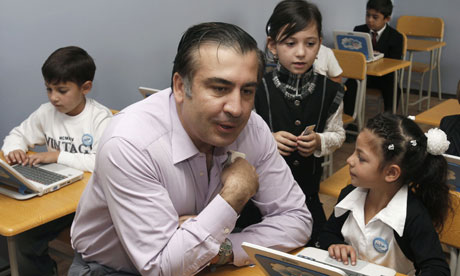
Georgia puts up Russian language barriers in schools


    English is being pushed onto syllabuses in a bid to break with a powerful neighbour to the north
  • georgia schools english
Georgia's President Mikheil Saakashvili launches the country's English language teaching programme at the start of the new school year. Photograph: David Mdzinarishvili/Reuters
With Alexander Pushkin's framed visage on the wall and creased editions of fellow Russian literary giants on dusty shelves, Natela Chokhonelidze's office recalls a very different era at Georgia's state university.
"We once had a staff of 50, and now there are five, because there aren't many students," said the 70-year-old professor emeritus at the university's institute of Russian studies. "Russian language is fading out," she quipped, "with me!"
Chokhonelidze is on the losing side of a deliberate shift in the former Soviet republic as its pro-western leadership tries to supplant Russian with English as the default second language of 21st-century Georgia.
Last month hundreds of native English speakers joined the first day of school as teaching assistants under an ambitious programme to have every child aged five to 16 speak English. English is now compulsory and Russian optional.
The aim appears pragmatic in a globalised world where English dominates and Georgia's investment-driven economy is seeking partners in Turkey and the European Union.
It fits neatly too, however, with President Mikheil Saakashvili's policy of dragging the Caucasus country of 4.5 million people out from Russia's orbit, two years after war shattered already fragile ties between the neighbours.
"We're a free and independent country and our people are free and independent. It's their choice which language to learn," said education minister Dmitry Shashkin, an ethnic Russian, in English.
The government plans to recruit 1,000 native-English speakers by the end of the year on $272 per month, eventually building up to one per school.
English "opens many doors", said Shashkin. "Georgia doesn't have oil, Georgia doesn't have natural gas. The resource we have is our people, the intellectual potential of our country."
On the streets of Georgia's capital Tbilisi, where blue European Union flags flutter outside the parliament building, all Georgians over the age of 40 speak Russian fluently. Shopkeepers are happy to converse in Russian. The younger, educated generation, however, prefer English, and can even bridle if you attempt to talk to them in the language of Georgia's powerful northern neighbour and adversary.
Much of this is generational. Students entering university now were born after the collapse of the Soviet Union in 1991. The influence of western pop culture and the internet is strong.
So too is the fallout from the deterioration in political relations with Russia since Georgia's 2003 Rose Revolution swept aside the ex-Soviet old guard and brought Saakashvili and his team of English-speaking ministers to power.
He set Georgian sights on joining Nato, to the anger of Russia. Political ties collapsed with the 2008 war, when Russia crushed an assault by Georgia's US-trained military on the rebel pro-Russian region of South Ossetia.
Trade links are minimal. Visa requirements and torturous travel routes have strained ties between family and friends.
"Taken in the wider context ... it seems there is a political element behind this," said Shorena Shaverdashvili, editor of Georgian weekly Liberali.
English should be taught, she said, but "Why replace one [language] with the other? This is our neighbourhood and the common language with our neighbours is Russian."
Georgia is now leading the retreat of Russian language in the post-Soviet Union. But Russian remains the lingua franca across much of the former Soviet empire. It is still understood and spoken from Moldova in the west to Kazakhstan and Tajikistan in what was once Soviet central Asia. In the cafes and bars of Dushanbe, Tajikistan's pleasant capital, middle-class Tajiks are more likely to talk to each other in Russian than in Tajik.
In communist times, Russian was taught in Soviet schools as the "language of communication between nationalities". For any ambitious student, especially in more far-flung parts of the Soviet Union, Russian was an essential springboard to a good university education and professional career.
Critics question the wisdom of relegating Russian to a third tier, pointing out that the quality of English teaching in Georgia and other independent post-Soviet countries is often very poor.
At the university, Chokhonelidze laments the passing of an era, and the generations brought up on reading Pushkin, Tolstoy and Dostoyevsky. "I fear in a few years when those grandfathers and grandmothers aren't around, nobody will bother."
The answer, said 20-year-old mathematics student Nugzar Barbakadze, is simple: "I can read Russian books in Georgian."

Tuesday, January 25, 2011

For better proficiency in foreign languages


Many options are available to study the French, Italian and Japanese languages.

— File Photo 

For correct intonation: Language labs play a major role in helping students get their pronunciation right.
We had in these columns during the past weeks listed 19 universities/ centres that provide good facilities for the study of foreign languages in India. Let us now look at a few more of them.
Alliance Francaise
Web site: www.afindia.org.
Alliance Française has a large network of more than a thousand associations in 136 countries, delivering French language courses to a total of 4,60,000 students. It also aims at cultural interaction among French-speaking peoples. There are 16 Alliances Françaises in India (Ahmedabad, Bangalore, Bhopal, Chandigarh, Chennai, Goa, Hyderabad, Jaipur, Karikal, Kolkata, Mahe, Mumbai, New Delhi, Pondicherry, Pune and Trivandrum).
The DELF and DALF examinations certify the students' levels in French. Teaching of the French language at the Alliance Française is progressive. They offer all levels of learning starting from level 1 (A1) to level 6 (C2).
The student is invited to actively participate in the class and to develop his powers of observation, thinking, and communication, and also use the four skills: oral and written comprehension, written and oral production. After every level, he continues his learning in the next higher level if authorised by the teacher. He can also have his skills validated by an internationally recognised diploma: the DELF and the DALF.
Sessions of 160 hours (Levels 1-3), 200 hours (Level 4) or 240 hours (Levels 5 and 6) to attain the objectives of each level.
Address of the Chennai centre: Alliance Française de Madras, No.24, College Road, Chennai 600 006; ph: 044-28279803, Web site: www.madras.afindia.org
Indo-Italian Chamber of Commerce and Industry (IICCI) is a non-profit organisation recognised by the Italian government, whose main objective is to promote and enhance trade and economic relations between India and Italy. It conducts classes in the Italian language at its different centres. Web site: www.indiaitaly.com.
Head Office: IICCI - Head Office, Mumbai, Bengal Chemicals Compound
502 Veer Savarkar Marg, Prabhadevi, Mumbai 400025; Ph: 022-24368186, e-mail for language lessons: language@indiaitaly.com.
Italian language courses at Mumbai:
Level I: Beginners Level, morning classes for two hours, three days a week. Duration: two months
Level II: Intermediate level, morning classes for two hours, two days a week. Duration: two months. Similar programmes are available at other centres. There is a third level (advanced) also. Contact details:
Bangalore: Ph: 080-26620318, e-mail: anup.tg@indiaitaly.com
Chennai: Ph: 044-28242399; e-mail:r.cardoza@indiaitaly.
com
Goa: Ph: 0832-2438946; e-mail: c.iuzzolini@indiaitaly.com
Kolkata: Ph: 033-32944677; e-mail:iicci.cal@indiaitaly.
com
The key objectives of the three levels are as follows:
First level, beginner: Understand and use familiar everyday expressions and very basic phrases. Introduce themselves and others. Ask and answer questions on personal details. Interact in a simple way, provided the other person talks slowly and clearly.
Second level, intermediate: Understand sentences and frequently used expressions related to areas of most immediate relevance (eg. very basic personal and family information, shopping, local geography, employment). Communicate on simple and routine tasks requiring direct exchange of information. Describe in simple terms aspects of their background, immediate environment and matters in areas of immediate need.
Third level, advanced: Understand the main points of clear standard input on familiar matters regularly encountered at work, school, leisure, etc. Deal with usual situations likely to arise while travelling in an area where the language is spoken. Produce simple connected text on topics that are familiar or that are of personal interest. Describe experiences and events and briefly give reasons and explanations for opinions and plans.
Students are examined at the end of each level. After the completion of the entire course, the Italian Embassy will award a Diploma.
Indo-Japan Chamber Of Commerce & Industry, No.21, K.B. Dasan Road, Teynampet, Chennai 600 018; Ph: 044-24352010, e-mail: indo-japan@ijcci.com; Web : www.ijcci.com. This promotes educational, cultural and commercial activities between Japan and India.
The Chamber conducts Japanese Language Classes throughout the year to prepare students for the different levels of the Japan Foundation's Japanese Language Proficiency Test (JLPT). Further, there are need-based conversation classes, both short-term and long-term, for the benefit of corporate houses. Special Japanese Language Classes are also conducted for students of professional colleges on request.
Distance education programmes are being conducted for the benefit of outstation students, even for appearing in JLPT. The course, among other things, effectively enables students to acquire basic skills in Japanese conversation. Interested candidates have the option to join a four-month advanced intensive Japanese conversation program, with four contact classes on Sundays.
JLPT lays stress on knowledge of Japanese including vocabulary, grammar, and competence in practical communication. These are measured through tests in language knowledge (vocabulary / grammar), reading and listening. The JLPT is offered in five levels (N1, N2, N3, N4, and N5). The easiest level is N5 and the most difficult level is N1. Levels N4 and N5 measure the level of understanding of basic Japanese mainly learned in the class. N1 and N2 measure the level of understanding of Japanese used in a broad range of scenes in actual everyday life. N3 is a bridging level between N1/N2 and N4/N5.
N5: Ability to read and understand typical expressions and sentences written in hiragana, katakana, and basic kanji / listen and comprehend conversations on topics in daily life, and to grasp information from short conversations spoken slowly.
N4: Abilities in N5 at some more depth.
N3: Ability to understand Japanese used in everyday situations / read slightly difficult writings encountered in everyday situations / listen and comprehend coherent conversations spoken at near-natural speed
N2: Ability to read and comprehend materials written clearly on a variety of topics, such as articles and commentaries in newspapers and magazines as well as simple critiques, and comprehend their contents / comprehend orally presented materials such as news reports, spoken at nearly natural speed.
N1: Ability to read and comprehend writings with logical complexity and/or abstract writings on a variety of topics, such as newspaper editorials / comprehend orally presented materials such as coherent conversations, news reports, and lectures, spoken at natural speed
The Japan Foundation, 5-A, Ring Road, Lajpat Nagar-IV, New Delhi 110 024 Web: www.jfindia.org.in, is an organization for international cultural exchange. It promotes Japanese language education, through various activities including teacher training.
The Ramakrishna Mission Institute of Culture, School of Languages, Golpark, Kolkata – 700029; Ph: 0332464 1303; e-mail: rmic@vsnl.com,
Web site: www.sriramakrishna.org
Junior courses of one year each, in French, German, Italian, Portuguese, Spanish, Arabic, Chinese, Japanese, Latin, Ancient Greek, and Persian
Senior Certificate courses of one year each, in French, Italian, Portuguese, Spanish, Arabic, Chinese, Japanese, Latin, and Persian
Advanced Certificate courses of one year each in Chinese, Japanese, French and Spanish.
Senior and Advanced Certificate courses, each of one year, in German.
Communicative Certificate courses, each of six months, in Chinese, French, German, Korean, Russian and Spanish.

The Eric Friedheim Library: Events and Classes

Business Affiliate Programs •  Sale •  Personals •  Advertising •  Shopping

LinkWithin

Related Posts Plugin for WordPress, Blogger...