This blog is about extraminds.com, world's 1st free edusocial portal, where you can get connected with your friends,family and can also enjoy free e-learning tools. You will get up-to-date information about CBSE Board, NCERT Textbooks, social networking activities, online games and lot more. Start exploring the blog now!
Taxpayers receive a dollar-for-dollar reduction on their taxes for up to $750 donated to a school tuition organization.
Arizona is expanding its private school tuition tax creditsonly a day after the U.S. Supreme Court found the program legal, The Arizona Republic reports. In a bill passed by a 27-1 vote, the state Senate has increased donation limits from $500 to $750. The bill also removes donation limits for corporations and insurance companies.
The tax credits allow Arizona taxpayers to divert their income to school tuition organizations and get a dollar-for-dollar reduction on their taxes. According to The Republic, state residents moved $51 million in such a way in 2009. According to the Arizona Department of Revenue, the limit increases will have an impact on the state income tax and state, county and local severance tax collections, reducing them by $25 million and $29 million respectively.
Supporters of the program say it is a money-saving measure for the fiscally crippled state, because it saves the school system $5,200 for every student that transfers out of a public school.
A fiscal analysis of the bill noted that the state would break even from the proposed changes if about 3,300 students transferred to private schools in 2012.
New Delhi: More than one lakh children in the national capital are still out of school, a report by the human resource development ministry said as the Right to Free and Compulsory Education (RTE) Act completed a year on Friday since its implementation.
The RTE report card which analyzed the primary education scenario in the country was released especially for the occasion.
According to the report, 1,24,022 children in the age group of six to 14 were out of school in Delhi, as per a survey in 2009. Across the country, the out-of-school children figure stands at 81,50,619.
"It's unfortunate that 81,50,619 children in the age group of six to 14 are still out of school. We have to bring all those children to school," Human Resource Development Minister Kapil Sibal said while releasing the report.
On a positive note however, Delhi has scored quite well in other parameters.
For instance, as compared to national figure of pupil-teacher ratio of 32, in Delhi the ratio is 28. Then, at the national level the percentage of teachers without professionalqualification is 21, but in Delhi it stands at one.
Water drinking facility is present in 100 percent schools in Delhi. 79 percent schoolshere have girls toilets, 71 percent schools have ramps for disadvantaged students, 75 percent schools have playground and 98 percent have boundary walls.
Delhi is one of the 11 states which have constituted a state commission to monitor implementation of the RTE Act. Notification of the state rules however is still "in process", the report said.
A total of 16,84,425 students have been enrolled in the primary level in Delhi and 9,82,164 in the upper primary level. Delhi has 3,034 government and aided schoolsand has 57,777 teachers in these schools.
New Delhi: More than one lakh children in the national capital are still out of school, a report by the human resource development ministry said as the Right to Free and Compulsory Education (RTE) Act completed a year on Friday since its implementation.
The RTE report card which analyzed the primary education scenario in the country was released especially for the occasion.
According to the report, 1,24,022 children in the age group of six to 14 were out of school in Delhi, as per a survey in 2009. Across the country, the out-of-school children figure stands at 81,50,619.
"It's unfortunate that 81,50,619 children in the age group of six to 14 are still out of school. We have to bring all those children to school," Human Resource Development Minister Kapil Sibal said while releasing the report.
On a positive note however, Delhi has scored quite well in other parameters.
For instance, as compared to national figure of pupil-teacher ratio of 32, in Delhi the ratio is 28. Then, at the national level the percentage of teachers without professional qualification is 21, but in Delhi it stands at one.
Water drinking facility is present in 100 percent schools in Delhi. 79 percent schoolshere have girls toilets, 71 percent schools have ramps for disadvantaged students, 75 percent schools have playground and 98 percent have boundary walls.
Delhi is one of the 11 states which have constituted a state commission to monitor implementation of the RTE Act. Notification of the state rules however is still "in process", the report said.
A total of 16,84,425 students have been enrolled in the primary level in Delhi and 9,82,164 in the upper primary level. Delhi has 3,034 government and aided schoolsand has 57,777 teachers in these schools.
The Electronics Engineering Association (EEA), MIT, Anna University, Chennai, is organising ELECTROFOCUS'11, its annual inter-collegiate national level technical symposium. Every year, more than 3000 students attend the fest from over 350 colleges around India. EEA is an educative association of the Department of Electronics that is committed to organising workshops and events to improve the practical understanding of students and brings out the spirit of innovation in the young engineers of this country. Web site: www.eea.mitindia.edu.
There is no tool more effective for development and poverty reduction than the education of girls. Today, on International Women’s Day, EI demands greater investment in and political commitment to achieving this goal.
In many countries around the world, basic education is not accessible to millions of people. Of the 796 million illiterate people, women make up two thirds. Girls and women face particular obstacles that keep them out of education: Violence on the way to school, in and around schools; early pregnancy and early marriage; vulnerability to the HIV epidemic, as well as discrimination based on gender stereotypes in the wider community and at schools; school fees, which may mean that parents send their boys and not their girls to school; and lack of gender sensitive quality education especially in rural areas.
EI Deputy General Secretary Jan Eastman said: “This early discrimination contributes fundamentally to the disadvantages that women are faced with in so many areas of life. Conversely, investing in girls’ education not only gives women and girls the tools to stand up against discrimination and violence, it is also a precondition for democracy and development. It raises economic productivity, lowers infant and maternal mortality, and leads to considerable improvements in families’ health and nutrition.”
A report released last week by the Education For All Fast Track Initiative shows the progress that girls have made not only in enrolling in school but also in completing their education. It highlights the most effective tools to achieve this progress: The mobilisation of communities to send girls to school, targeted financial support for girls to cover for school fees and textbook costs, and the creation of school health and feeding programs. “Education to at least secondary level is crucial for the empowerment of girls,” said Eastman.
Using the slogan “It is a right! Make it right!”, women’s and girls’ right to education is the theme of this year’s Global Action Week from 2 to 8 May 2011. Under the heading “The Big Story” millions of people around the world will share stories on women’s and girls’ education. The main aim of the Global Action Week will be to urge leaders to make specific policy pledges which must be followed through and implemented. EI advocates for greater investment in the education of girls, today and every other day of the year.
New Delhi: Six eminent scholars from Pakistan, the UK and Sweden will participate in a two-day international seminar on "The State of Pakistan" on Thursday organized by the Jamia Millia Islamia.
The main objective of the seminar is to discuss and understand politics and the state in Pakistan.
"In recent years, the concerns about Pakistan's security and stability have been so overwhelming that the politics of Pakistan has not received adequate attention," a press statement said.
The event is organized by the Pakistan StudiesProgramme at the Academy of Third World Studies in Jamia.
"The seminar will focus on the significant political developments in Pakistan and it will help gain deeper in sights into the new developments and challenges the country is facing today," the statement added.
Meghalaya ranks way below the national average in imparting elementary education in the country, according to the Annual Status of Education Report (ASER), 2010.
The national average of children in the 3-4 years age group in 'anganwadi' schools is 75.7 percent, whereas Meghalaya's average is way below at 46.7 percent, revealed the report, released on Thursday by Leader of Opposition Conrad K. Sangma.
According to the report, the national average of children in the age group of 6-14 out of school is 3.5 percent and Meghalaya's average is more that double at 7.2 percent.
Moreover, children between ages 3 and 6 years not attending any kind of pre-school is very high in Meghalaya and the percentage of such children in the state is increasing year after year since 1997.
Amongst the seven districts of the state, Jaintia Hills fares the worst in impartingelementary education, the report stated.
The report comes as no surprise since pre-school teachers, mostly in rural areas, are still getting a salary of Rs.1,800 despite many appeals to the government. This salary has remained unchanged for the past ten years, so many of these teachers juggle between several jobs to make ends meet.
"Many of the elementary school teachers have outsourced their jobs to others. In return they get 50 percent of the salary and carry on other work," the report said.
"In such a scenario, how can the state expect to do well in imparting elementary education," Sangma said.
He also claimed that the central government's flagship programme - the Mahatma Gandhi National RuralEmployment Guarantee Scheme - has also lured children away from the schools in the villages.
"Many school children are not attending their classes and are taking up jobs under the MGNREGS. The state government must ensure that such instances do not take place," Sangma said.
This year, the total number of applicants for the joint entrance exam (JEE), have gone up by 5,000 as compared to last year, to get the most coveted seat in the Indian Institutes of Technology (IITs) from Mumbai zone.
While number of applicants from Mumbai is almost the same, there is a substantial growth in the number of applicants from tier-II cities like Nagpur and Jaipur this year, which also falls in the Mumbai zone.
The total numbers of applicants across the country has gone up from over 4.5 lakh to 5.3 lakh this year. Over 5.3 lakh candidates across the country would be vying for 9,600 seats in IITs.
From the Mumbai zone itself, which also has the highest numbers of applicants from the seven zones, 85,169 students have applied for the IIT-JEE. Students from Maharashtra, Goa, Rajasthan, Gujarat and Belgaum from Karnataka also apply from the Mumbai zone.
According to the chairman of IIT-JEE from IIT-Bombay, Abhijeet Chatterjee, candidates from tier-II cities contribute the most to the increase in numbers.
English is being pushed onto syllabuses in a bid to break with a powerful neighbour to the north
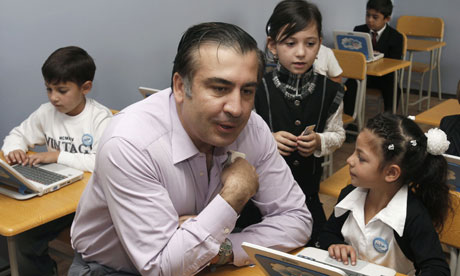
Georgia's President Mikheil Saakashvili launches the country's English language teaching programme at the start of the new school year. Photograph: David Mdzinarishvili/Reuters
With Alexander Pushkin's framed visage on the wall and creased editions of fellow Russian literary giants on dusty shelves, Natela Chokhonelidze's office recalls a very different era at Georgia's state university.
"We once had a staff of 50, and now there are five, because there aren't many students," said the 70-year-old professor emeritus at the university's institute of Russian studies. "Russian language is fading out," she quipped, "with me!"
Chokhonelidze is on the losing side of a deliberate shift in the former Soviet republic as its pro-western leadership tries to supplant Russian with English as the default second language of 21st-century Georgia.
Last month hundreds of native English speakers joined the first day of school as teaching assistants under an ambitious programme to have every child aged five to 16 speak English. English is now compulsory and Russian optional.
The aim appears pragmatic in a globalised world where English dominates and Georgia's investment-driven economy is seeking partners in Turkey and the European Union.
It fits neatly too, however, with President Mikheil Saakashvili's policy of dragging the Caucasus country of 4.5 million people out from Russia's orbit, two years after war shattered already fragile ties between the neighbours.
"We're a free and independent country and our people are free and independent. It's their choice which language to learn," said education minister Dmitry Shashkin, an ethnic Russian, in English.
The government plans to recruit 1,000 native-English speakers by the end of the year on $272 per month, eventually building up to one per school.
English "opens many doors", said Shashkin. "Georgia doesn't have oil, Georgia doesn't have natural gas. The resource we have is our people, the intellectual potential of our country."
On the streets of Georgia's capital Tbilisi, where blue European Union flags flutter outside the parliament building, all Georgians over the age of 40 speak Russian fluently. Shopkeepers are happy to converse in Russian. The younger, educated generation, however, prefer English, and can even bridle if you attempt to talk to them in the language of Georgia's powerful northern neighbour and adversary.
Much of this is generational. Students entering university now were born after the collapse of the Soviet Union in 1991. The influence of western pop culture and the internet is strong.
So too is the fallout from the deterioration in political relations with Russia since Georgia's 2003 Rose Revolution swept aside the ex-Soviet old guard and brought Saakashvili and his team of English-speaking ministers to power.
He set Georgian sights on joining Nato, to the anger of Russia. Political ties collapsed with the 2008 war, when Russia crushed an assault by Georgia's US-trained military on the rebel pro-Russian region of South Ossetia.
Trade links are minimal. Visa requirements and torturous travel routes have strained ties between family and friends.
"Taken in the wider context ... it seems there is a political element behind this," said Shorena Shaverdashvili, editor of Georgian weekly Liberali.
English should be taught, she said, but "Why replace one [language] with the other? This is our neighbourhood and the common language with our neighbours is Russian."
Georgia is now leading the retreat of Russian language in the post-Soviet Union. But Russian remains the lingua franca across much of the former Soviet empire. It is still understood and spoken from Moldova in the west to Kazakhstan and Tajikistan in what was once Soviet central Asia. In the cafes and bars of Dushanbe, Tajikistan's pleasant capital, middle-class Tajiks are more likely to talk to each other in Russian than in Tajik.
In communist times, Russian was taught in Soviet schools as the "language of communication between nationalities". For any ambitious student, especially in more far-flung parts of the Soviet Union, Russian was an essential springboard to a good university education and professional career.
Critics question the wisdom of relegating Russian to a third tier, pointing out that the quality of English teaching in Georgia and other independent post-Soviet countries is often very poor.
At the university, Chokhonelidze laments the passing of an era, and the generations brought up on reading Pushkin, Tolstoy and Dostoyevsky. "I fear in a few years when those grandfathers and grandmothers aren't around, nobody will bother."
The answer, said 20-year-old mathematics student Nugzar Barbakadze, is simple: "I can read Russian books in Georgian."