This blog is about extraminds.com, world's 1st free edusocial portal, where you can get connected with your friends,family and can also enjoy free e-learning tools. You will get up-to-date information about CBSE Board, NCERT Textbooks, social networking activities, online games and lot more. Start exploring the blog now!
New Delhi: More than one lakh children in the national capital are still out of school, a report by the human resource development ministry said as the Right to Free and Compulsory Education (RTE) Act completed a year on Friday since its implementation.
The RTE report card which analyzed the primary education scenario in the country was released especially for the occasion.
According to the report, 1,24,022 children in the age group of six to 14 were out of school in Delhi, as per a survey in 2009. Across the country, the out-of-school children figure stands at 81,50,619.
"It's unfortunate that 81,50,619 children in the age group of six to 14 are still out of school. We have to bring all those children to school," Human Resource Development Minister Kapil Sibal said while releasing the report.
On a positive note however, Delhi has scored quite well in other parameters.
For instance, as compared to national figure of pupil-teacher ratio of 32, in Delhi the ratio is 28. Then, at the national level the percentage of teachers without professional qualification is 21, but in Delhi it stands at one.
Water drinking facility is present in 100 percent schools in Delhi. 79 percent schoolshere have girls toilets, 71 percent schools have ramps for disadvantaged students, 75 percent schools have playground and 98 percent have boundary walls.
Delhi is one of the 11 states which have constituted a state commission to monitor implementation of the RTE Act. Notification of the state rules however is still "in process", the report said.
A total of 16,84,425 students have been enrolled in the primary level in Delhi and 9,82,164 in the upper primary level. Delhi has 3,034 government and aided schoolsand has 57,777 teachers in these schools.
New Delhi: The absence of a clear grievanceredressal structure for the Right To Education (RTE) law was questioned on Thursday by the National Commission for Protection of Child Rights (NCPCR).
The NCPCR is the apex body that ensures the implementation of the RTE Act in the country.
It has been a year since the law had been brought to action in India. However, the NCPCR has cited the lethargy on the part of most state governments that have failed to notify key rules for the successful implementation of the RTE.
National RTE Coordinator at the NCPCR Kiran Bhatty said that there was definite tardiness in the implementation of the act. "We have written to the state governments repeatedly and would still keep on writing to them," she said.
Guidelines for a redressal mechanism for the RTE have also been proposed by the NCPCR to theHuman Resource Development (HRD) ministry. These guidelines are currently being examined by the law ministry.
According to the RTE Act, the NCPCR, chaired by Magsaysay Award winner Shantha Sinha, is the watchdog body for the implementation of the right to education all over the country. The NCPCR had been given the role with the aim to ensure and the implementation of and independently monitor the law instead of the HRD ministry.
Section 36 of the RTE Act says that the state governments are required to appoint designated local authorities who are empowered to sanction prosecution of school or government officials for conducting screening tests, corporal punishments or running unrecognized schools.
Vinod Raina, a member of the National Advisory Council on the RTE Act has informed that only 13 of the 36 states and union territories have notified about the rules accompanying the Act or notified the authorities.
Matthew Lynch - With skyrocketing costs, budget crises, inconsistent curricula, poor standardized testing scores, and poor morale among teachers, administrators, and students, the need for sustainable and pervasive educational change is greater now than ever before.
The numbers of questions related to the quality of the U.S. educational system from multiple sectors of society is at an all-time high. Many American parents have seen reports that American schools rank well below schools in countries such as China and Japan, or have heard President Obama declare a “dropout crisis” in the USA. An abundance of news reports and discouraging case studies has created panic among education stakeholders, who want to know why American school systems are failing. However, many insist on playing the “blame game,” which in most cases is counterproductive.
Many Americans believe that only a small percentage of leaders understand the complexities of the school system, and that individuals who do understand the intricacies of the system use their knowledge to justify the mediocre performance of our teachers and students. The American school system is the best-financed system in the world, but is one of the lowest performing. The American school system as a whole has an appalling performance record. For children living in urban environments, the story is even more alarming. Students from low socioeconomic backgrounds are often educated in dilapidated schools where the too many educators lack the credentials and skills necessary to perform their duties adequately. High student-to-teacher ratios are found in most urban schools, and these schools often lack the resources to deal with the diverse challenges they face, including unruly student behavior. Education has been called the great equalizer, but for students living in poverty-stricken urban areas it is little more than a babysitting service and a place to get a hot meal.
Many question whether the No Child Left Behind Act has contributed to achieving academic success. Although NCLB was well intentioned, it has not lived up to the hopes of government or schools. In the eyes of some, NCLB has actually contributed to subpar academics becoming even worse. If American educators and school personnel do not make a concerted effort to develop effective measures to hold schools accountable for the education of all of our children, then the education crisis will continue.
There is an exception to every rule: some urban school systems are providing a quality education. Unfortunately, however, only a small number of school systems meet the state and federal government student performance requirements. For underperforming urban school systems, the problem usually lies with the inability to sustain existing reform efforts and initiatives. Mayors and school superintendents in these areas often concoct grandiose reform plans that are merely political devices meant to beguile voters into believing they genuinely care about educational reform. The idea that politicians create school reform to gain popularity and votes is sad and sobering. It is discouraging to realize that our children’s futures might be used as a political device to win elections.
Politicians are not the only people at fault for the shoddy education American children are receiving, but no one will take responsibility for subpar educational environments. If administrators were asked who was at fault, they might point to a lack of parental involvement and too few quality teachers. If teachers were asked who was at fault they might also cite a lack of parental involvement and ineffective administration. If parents were asked who was at fault they might blame teachers and school administrators. Society in general seems to conclude that the lack of quality teachers, effective administration, and parental involvement are all factors contributing to educational failure.
Whatever the reason, Americans have become the laughing stock of the free world when it comes to K-12 education. The solution, of course, is for the country to unite and work together to carry the responsibility of enriching and continuing America’s future via educational excellence without playing the “blame game.”
CAIRO : Partial results from a third of Egypt's provinces on Sunday showed massive turnout and a vote overwhelmingly in favour of constitutional changes that eliminate restrictions on political rights and civil liberties.
The count from most of the country, including Cairo, was still to be released.
But results from 10 of 29 provinces showed 65 to 86 per cent of voters saying “yes” to the changes, which would allow national elections no later than September. Opponents feared the referendum's passage would allow the highly organised Muslim Brotherhood to dominate Egypt's dozens of new political parties in the presidential and parliamentary vote.
Millions of Egyptians voted freely on Saturday for the first time in more than half a century, joyfully waiting for hours to cast their ballots on the package of constitutional changes.
Among other changes, the constitutional amendments would open elections to independent candidates, allowing parliamentary and presidential elections to replace the caretaker military government by early 2012.
Alarmed over the staggering number of childrenwho are not attending schools, the Rajasthan government has directed that each government principal be given a target to bring back students who have dropped out.
According to a child tracking system (CTS) survey conducted by the state's education department, 1.2 million students are out of schools in Rajasthan. And the state's Directorate of Primary Education in Bikaner moved last week to rectify the situation.
"District education officers (DEO) have been asked to provide the list of drop-out children to government schoolprincipals in each district," a senior education departmentofficer told the sources.
"Based on the ratio of drop-out children and thegovernment teachers in each school, the teachers will be given targets. They will have to bring these children to schools," he explained.
It will be the responsibility of the principals to ensure that children who get admission in their schools stay till they complete the education, he added.
"The orders regarding this were issued on Saturday," he said.
The directorate also plans to run special drives to bring drop-out children to school from May 1 to May 16 and July 1 to July 15 this year.
"We have sought permission regarding this from the state government and the programme details will be announced as soon as we get the nod," said the officer.
According to the CTS survey, at least 30,996 children between the age group 6-14 are not going to school in the state capital Jaipur alone.
Child rights activists in the state say the orders will have to be implemented strictly for positive results.
"It is still not clear what action will be taken against the teachers who fail to meet the given targets," said Vikram Sharma, an activist.
The Indian Government has turned down an American offer to provide experts for teaching English in the Indian Madrassas.
The Human Resources Development department has flatly refused the US proposal of sending Americans to teach English to the Madtrassa schools in various parts of the country.
The US proposal, which came through the ministry of External Affairs, has been rejected on the ground that the Indian government does not want to interfere in the functioning of Madrassas. “Our policy is of non-interference. The Indian government does not play any proactive role and simply monitors educational schemes for Muslims through its minority cell,” Times of India reported quoting the HRD sources as saying.
In India many Madrassas, where Urdu is taught, have already started teaching English.
India has about 7,000 registered Madrassas with some 3.5 lakh students on their rolls.
Another reason, though unstated, is the fear of evoking a political outcry.
“US is seen as an aggressor by Muslims. Any attempt to bring American teachers in madrassas would have been seen as interference,” a source was quoted as saying.
Germany’s federal government recently introduced its Nanotechnology Action Plan 2015. The comprehensive approach extends and expands upon a previous programme, which provided 400 million euros in public funding for nanotechnology research in 2010 – the highest level in Europe.
“Nanotechnology reaches across industries and research disciplines. In Germany, excellent cooperation between academic institutions, research establishments, and industry players creates excellent chances for foreign investors. With nanotechnology, we can better address a range of global challenges from mobility and energy to healthcare and communication,” according to Rainer Mueller, Senior Manager for Nanotechnology at Germany Trade & Invest in Berlin.
German nanotechnology activities are the most intensive in Europe in terms of public and private funding, patents, active companies and targeted initiatives. With nearly 2,000 players, Germany is the European frontrunner in both research and commercialisation of nanotechnology products and processes. A total of nine national nanotechnology clusters have developed.
The government has refused to give a name to the first reform in nearly two decades in the way India selects its key civil servants. The Union Public Service Commission (UPSC) on Saturday notified the public notice for the changed civil services examination that will give at least 880 candidates the
dream job. About 4 lakh people apply for the prestigious examination every year and only half of them are able to take the examination.
The preliminary examination slotted for June 12 this year will be the first after the government changed the syllabus to incorporate what was dubbed as an "aptitude test".
Saturday's notification describes the alterations made to the syllabus for the preliminary examination but does not give it a new name (Civil Service Aptitude Test) — as proposed by the UPSC.
A senior government official told HT that the Department of Personnel and Training — the government's HR manager — had turned down the UPSC request.
"It was felt that even in its new format too, the examination did not really test the candidates’ aptitude… it just has a little more mathematics, English and logical reasoning," the official said.
Meghalaya ranks way below the national average in imparting elementary education in the country, according to the Annual Status of Education Report (ASER), 2010.
The national average of children in the 3-4 years age group in 'anganwadi' schools is 75.7 percent, whereas Meghalaya's average is way below at 46.7 percent, revealed the report, released on Thursday by Leader of Opposition Conrad K. Sangma.
According to the report, the national average of children in the age group of 6-14 out of school is 3.5 percent and Meghalaya's average is more that double at 7.2 percent.
Moreover, children between ages 3 and 6 years not attending any kind of pre-school is very high in Meghalaya and the percentage of such children in the state is increasing year after year since 1997.
Amongst the seven districts of the state, Jaintia Hills fares the worst in impartingelementary education, the report stated.
The report comes as no surprise since pre-school teachers, mostly in rural areas, are still getting a salary of Rs.1,800 despite many appeals to the government. This salary has remained unchanged for the past ten years, so many of these teachers juggle between several jobs to make ends meet.
"Many of the elementary school teachers have outsourced their jobs to others. In return they get 50 percent of the salary and carry on other work," the report said.
"In such a scenario, how can the state expect to do well in imparting elementary education," Sangma said.
He also claimed that the central government's flagship programme - the Mahatma Gandhi National RuralEmployment Guarantee Scheme - has also lured children away from the schools in the villages.
"Many school children are not attending their classes and are taking up jobs under the MGNREGS. The state government must ensure that such instances do not take place," Sangma said.
The All India Institute of Medical Sciences (AIIMS), New Delhi, has invited applications for entrance examination to be held on June 1for admission to the MBBS course commencing from August 1. AIIMS is one of the most reputed institution functioning under the Government of India, providing quality medical education.
Those who have passed higher secondary/ 10 + 2/ equivalent examination with physics, chemistry, biology and English securing at least 60 per cent marks (50 per cent for SC/ ST applicants) taken together are eligible to apply.
Students who are appearing for Plus Two examination in 2011 can apply. Applicants should have attained 17 years as on December 31. Both online and offline application facilities are provided from February 15 onwards. Apply online through the web site www.aiimsexams.org before March 15 as per instructions given in the prospectus.
The prospectus-cum-application form can also be obtained by speed / registered post by sending a requisition letter along with a crossed bank draft for Rs.1,050 (Rs.850 for SC/ ST category) drawn in favour of the Accounts Officer (Exams), AIIMS-MBBS- 2011 to the Assistant Controller of Examinations, All India Institute of Medical Sciences, Ansari Nagar, New Delhi - 110608 so as to reach the addressee on or before March 10. The last date for receipt of completed applications at the examination section of the AIIMS is March 15. For more details visit www.aiimsexams.org or www.aiims.edu.
HUTTO, Tex. — The school superintendent in this rural town outside the state capital has taken steps to trademark the district’s oddly un-Texan school mascot — the Hutto Hippo — in a frantic effort to raise cash. He is also planning to put advertisements on school buses and to let retailers have space on the school Web site.
Case Sherva, a fifth grader, helped a teacher, Paul Suddeth, lower the Texas state flag after school at Veterans’ Hill Elementary School in Hutto, Tex. State budget cuts are forcing the district to close the three-year-old school.
“I’m doing some weird stuff in the district because we are low on money,” said the superintendent, Douglas Killian, sitting in an office full of Hippo figurines.
He added, “We hope to make our hippo as recognizable as Mickey Mouse.” (The mascot was adopted shortly after a hippopotamus escaped from a circus train in 1915 and took up temporary residence in a local creek.)
But the money expected from the sale of “Hustling Hippos” merchandise would be peanuts compared with the hole expected to open up in the district’s budget, as the Legislature moves to slash about $4.8 billion in state aid to schools over two years to close a budget gap.
So Mr. Killian and the beleaguered school board have agreed to shut down a recently built grade school and to cut a 10th of the staff, among them a principal, 2 assistant principals, 4 librarians and 38 teachers. That round of staff cuts is a just first step, he says, and layoffs will follow if the budget bills proposed in the Legislature are enacted without changes.
All across Texas, school superintendents are bracing for the largest cuts to public education since World War II, and the state is not alone. Schools across the country are in trouble as billions in emergency stimulus grants from the federal government have run out, and state and federal lawmakers have interpreted the victory of fiscal hawks in November’s midterm elections to mean that tax increases are out of the question.
Nowhere has that political trend been more potent than in Texas, where Republicans who ran on a promise to never raise taxes not only retained every statewide office, but also added to their majorities in both houses of the Legislature.
Gov. Rick Perry, easily re-elected in November, made it clear in his annual speech to lawmakers last week that he regarded raising revenue for schools as out of the question, saying Texas families “sent a pretty clear message with their November votes.” He has also refused to consider using $9.4 billion in a reserve fund to bail out the schools.
“They want government to be even leaner and more efficient,” Mr. Perry said, “and they want us to balance the budget without raising taxes on families and employers.”
To balance the budget with cuts alone, the governor and Republican leaders in the Legislature have put forth bills that would reduce the state’s public school budget by at least 13 percent — nearly $3.5 billion a year — and would provide no new money to schools for about 85,000 new students that arrive in Texas every year. School administrators predict that as many as 100,000 school employees would have to be laid off to absorb the cuts.
Not only are the proposed cuts to school aid draconian, but in addition the Legislature in 2006 put strict limits on how much districts can raise local property taxes. That means local school boards find themselves trapped amid rising enrollment, double-digit drops in state aid and frozen local taxes.
Many school administrators attribute the current budget crisis to an overhaul of the school finance system five years ago, which Mr. Perry and Republican leaders pushed through in response to popular anger over high property taxes. The Legislature put a cap on property taxes for schools and promised to make up the difference with a new business tax. But that tax has never produced enough revenue to make the districts’ budgets whole.
The chronic shortfall in money for schools was papered over in the last two-year budget passed in 2009. Mr. Perry and Republican leaders in the Legislature used about $3.3 billion in federal aid under the American Recovery and Reinvestment Act to plug the hole. That aid has disappeared this year.
“We had a problem before the shortfall ever occurred,” said John M. Folks, the superintendent of Northside Independent School District in San Antonio. “Now we have put this shortfall on top of an already horrible funding situation.”
Mr. Folks said the proposed budget bills would require him to cut about a sixth of his budget, and he sees see no way to avoid laying off teachers and letting classes become larger.
Students and teachers across Tunisia have resumed their classes after weeks of protests that brought down the government of former President Ben Ali, but the debates continue about how to shape a new Tunisia.
Prior to the resignation of former President Ben Ali his Education Minister had shut down all education institutions during the exam period.
With a new Education Minister in post, schools have now resumed, and for the past two weeks, despite the insecurity and impassioned discussion on the shape of democratic developments in Tunisia, most students are able to take their exams.
In acknowledgement of Tunisians placing a high value on education, all students who missed classes, either because they were unable to return from the safety of their rural villages or because they were involved in protest action for or against the transition government, will have the opportunity to take their exams at a later date.
Eye witness accounts tell the story of insecurity within colleges and across the country. Higher education institutions are quieter because many older students have been engaged in debates about the current reforms. Civil society groups and the judiciary continue to be locked in debates about the next steps for Tunisia.
The transition President has been appointed, and not elected. The parliament continues to be composed of representatives from Ben Ali's dominant political party who are considered illegitimate by the people, but the infrastructure is not in place to enable parliamentary elections to happen quickly.
The opposition movement began as a popular uprising with unemployed young people and the energetic spirit of mobilisation continues to be active. Passionate debates about reform have replaced protests on the streets. Freedom of expression is being exercised fully, especially within universities.
While the transition government is not universally accepted, the old cadres have been ousted and new ministers with expertise have been coopted. However, the political experience is taking its toll. On 9 February, teachers from the primary and secondary education sector staged demonstrations to protest at offensive statements made by some newly appointed ministers.
Ordinary citizens, not just the intellectuals, want to understand how the democratic reforms can be implemented. There are reflections on what to keep from the 1958 Republican Constitution, what role civil society organisations can and must play. The trade union centre, UGTT, which played a major role in coordinating the so-called Jasmin Revolution across the country is represented in many commissions which are now developing new policies.
People are feeling inspired. They feel that they finally have a real say and want to be sure to take the right steps to preserve the integrity of these historic events.
Students whose family income is below £25,000 would pay £6,000 and receive a maintenance bursary of up to £1,625
Cambridge university wants to triple fees in autumn next year.
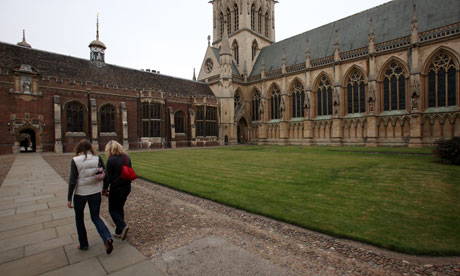
Senior managers at Oxford and Cambridge universities are intent on charging £9,000 a year in tuition fees, the maximum allowed, it has emerged.
A consultation paper shows Cambridge wants to almost triple fees to £9,000 as soon as it can in autumn next year. The university will charge the maximum of £3,375 for this autumn.
Students whose family income is below £25,000 would pay £6,000 and receive a maintenance bursary of up to £1,625, under plans from Cambridge's working group on fees, published internally for consultation. Means testing will taper this £3,000 reduction to zero when family income exceeds £42,000.
Oxford's pro-vice-chancellor, Tony Monaco, has said fees of less than £8,000 would lose the university money because of national cuts to teaching and other grants. He told a Congregation, a formal meeting of senior members of the university, that Oxford subsidised undergraduates by £80m.
"That is already straining research and infrastructure ... Were we to charge £9,000, the additional income would be £14m a year." This would be used to improve outreach activities and waive fees for the poorest students.
The university calculates that to waivefees for the poorest by £3,000, would be the equivalent of charging all undergraduates £8,500. Oxford will make its decision on fees in March.
David Willetts, the universities minister, has said fees of £9,000 will be allowed only in "exceptional circumstances". MPs voted to raise tuition fees in December, after the Lib Dems pledged in their manifesto to scrap fees. The government loans students the fees until they graduate and are earning £21,000 a year.
Aaron Porter, president of the National Union of Students, said: "We can now expect a race to the top now as universities rush to gain kudos by joining the '£9,000 group' as quickly as possible. How long before the most expensive start asking for the freedom to charge even more?"
The Cambridge report argues that even at £9,000, the university is still "carrying the burden of a significant loss per student … To charge less than the maximum would be fiscally irresponsible. Most if not all of our peers will charge the maximum."
A university spokesman said: "This report has been published online for consultation … It follows due consideration by a working party made up of senior academic, college and student representatives."
Universities are expected to raise fees to at least £6,000. They have to submit their plans to the government's Office for Fair Access, which can decline proposals.
New universities say they will be forced to raise fees to more than £6,000 because of cuts to teaching funds, and are concerned that students from low-income families will not be able to afford them.
Language shortage
Universities must urgently address the country's shortage of linguists, the British Academy warns. There is a growing mismatch between supply and demand in language skills, it argues in a report – Language Matters More and More. The situation has worsened since the academy's previous warning in 2009, it said. In 2010, 57% of UK pupils took no language at GCSE, while the number of A level language candidates fell by a quarter. There is a higher proportion of privately-schooled students on language courses than ever.
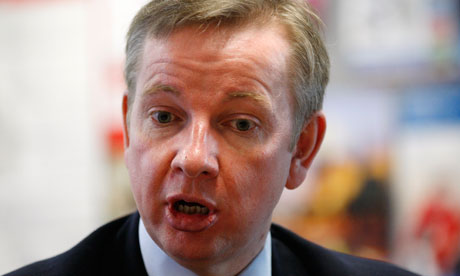
Gove said he had warned the last government that state-school pupils were being 'misled' about qualifications. Photograph: Sang Tan/AP
Education secretary Michael Gove today blamed the Labour government for "betraying a generation" by allowing thousands of pupils to take "soft" subjects at school.
Gove was commenting on the Guardian's revelation that top universities are issuing guidance which acknowledges officially for the first time that they favour students who study traditional subjects at A-level.
A handbook compiled by the Russell Group, a lobbying group for Oxford, Cambridge and 18 other leading universities, confirms rumours that have circulated for years that they favour traditional academic subjects over newer ones such as business studies and photography.
Gove said he had warned the last government that state-school pupils were being "misled" about qualifications. "A generation have been betrayed by Labour ministers who denied poorer children the chance to go to top universities," he said today.
Gove said the government was trying to reverse the "dramatic" rise in the number of children taking "less rigorous, non-academic qualifications".
For the first time this year, annual league tables – published last month – measured schools' performance by the proportion of pupils who obtain the new "English baccalaureate". This is awarded to teenagers who achieve GCSEs in English, maths, a science, a foreign language and a humanity, such as history or geography, at grade C or above. "This reflects the subjects the Russell group universities have said they value most," Gove said.
In 2004, about 15,000 non-academic qualifications were taken in schools. By 2010, this had risen to about 575,000.
Andy Burnham, Labour's shadow education secretary, said that while a clear focus on academic rigour was important, society needed a broad view of success. "We must also focus more on developing routes into work for young people who don't plan to go to university. Michael Gove has very little to say to these young people, and his curriculum and league table reforms are sending a very clear message that vocational learning is second best," Burnham said.
"With youth unemployment at a record high, we need to equip young people with a broad range of knowledge and skills to help them enter the modern workforce."
Labour had made changes to focus the curriculum on English and maths, and the take-up of single sciences had increased "significantly" as a result of Labour policies, he said.
Burnham had previously accused Gove of foisting a vision of education from the 1950s on to students and schools. "It is a strange message indeed in this day and age to say it's OK to do Latin but not ICT," he said.
English is being pushed onto syllabuses in a bid to break with a powerful neighbour to the north
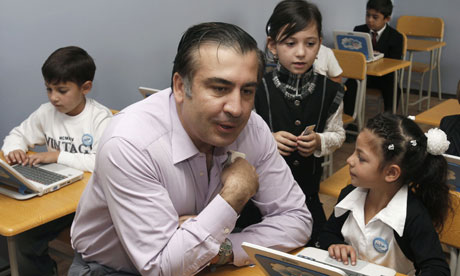
Georgia's President Mikheil Saakashvili launches the country's English language teaching programme at the start of the new school year. Photograph: David Mdzinarishvili/Reuters
With Alexander Pushkin's framed visage on the wall and creased editions of fellow Russian literary giants on dusty shelves, Natela Chokhonelidze's office recalls a very different era at Georgia's state university.
"We once had a staff of 50, and now there are five, because there aren't many students," said the 70-year-old professor emeritus at the university's institute of Russian studies. "Russian language is fading out," she quipped, "with me!"
Chokhonelidze is on the losing side of a deliberate shift in the former Soviet republic as its pro-western leadership tries to supplant Russian with English as the default second language of 21st-century Georgia.
Last month hundreds of native English speakers joined the first day of school as teaching assistants under an ambitious programme to have every child aged five to 16 speak English. English is now compulsory and Russian optional.
The aim appears pragmatic in a globalised world where English dominates and Georgia's investment-driven economy is seeking partners in Turkey and the European Union.
It fits neatly too, however, with President Mikheil Saakashvili's policy of dragging the Caucasus country of 4.5 million people out from Russia's orbit, two years after war shattered already fragile ties between the neighbours.
"We're a free and independent country and our people are free and independent. It's their choice which language to learn," said education minister Dmitry Shashkin, an ethnic Russian, in English.
The government plans to recruit 1,000 native-English speakers by the end of the year on $272 per month, eventually building up to one per school.
English "opens many doors", said Shashkin. "Georgia doesn't have oil, Georgia doesn't have natural gas. The resource we have is our people, the intellectual potential of our country."
On the streets of Georgia's capital Tbilisi, where blue European Union flags flutter outside the parliament building, all Georgians over the age of 40 speak Russian fluently. Shopkeepers are happy to converse in Russian. The younger, educated generation, however, prefer English, and can even bridle if you attempt to talk to them in the language of Georgia's powerful northern neighbour and adversary.
Much of this is generational. Students entering university now were born after the collapse of the Soviet Union in 1991. The influence of western pop culture and the internet is strong.
So too is the fallout from the deterioration in political relations with Russia since Georgia's 2003 Rose Revolution swept aside the ex-Soviet old guard and brought Saakashvili and his team of English-speaking ministers to power.
He set Georgian sights on joining Nato, to the anger of Russia. Political ties collapsed with the 2008 war, when Russia crushed an assault by Georgia's US-trained military on the rebel pro-Russian region of South Ossetia.
Trade links are minimal. Visa requirements and torturous travel routes have strained ties between family and friends.
"Taken in the wider context ... it seems there is a political element behind this," said Shorena Shaverdashvili, editor of Georgian weekly Liberali.
English should be taught, she said, but "Why replace one [language] with the other? This is our neighbourhood and the common language with our neighbours is Russian."
Georgia is now leading the retreat of Russian language in the post-Soviet Union. But Russian remains the lingua franca across much of the former Soviet empire. It is still understood and spoken from Moldova in the west to Kazakhstan and Tajikistan in what was once Soviet central Asia. In the cafes and bars of Dushanbe, Tajikistan's pleasant capital, middle-class Tajiks are more likely to talk to each other in Russian than in Tajik.
In communist times, Russian was taught in Soviet schools as the "language of communication between nationalities". For any ambitious student, especially in more far-flung parts of the Soviet Union, Russian was an essential springboard to a good university education and professional career.
Critics question the wisdom of relegating Russian to a third tier, pointing out that the quality of English teaching in Georgia and other independent post-Soviet countries is often very poor.
At the university, Chokhonelidze laments the passing of an era, and the generations brought up on reading Pushkin, Tolstoy and Dostoyevsky. "I fear in a few years when those grandfathers and grandmothers aren't around, nobody will bother."
The answer, said 20-year-old mathematics student Nugzar Barbakadze, is simple: "I can read Russian books in Georgian."