This blog is about extraminds.com, world's 1st free edusocial portal, where you can get connected with your friends,family and can also enjoy free e-learning tools. You will get up-to-date information about CBSE Board, NCERT Textbooks, social networking activities, online games and lot more. Start exploring the blog now!
Teachers at the Delhi University have decided to protest against the implementation of thesemester system in colleges, not by conducting strikes, but by holding classes outside in the lawns.
Members of the Joint Action body (JAB) ofteachers will on Thursday and Friday, conduct classes in the lawns outside the office of the vice chancellor to draw his attention to the matter of implementing the semesters for undergraduatecourses.
Karen Gabriel, associate professor at St. Stephen's College and a member of JAB said that JAB currently had around 100 members. Out of these, around 20 are expected to take their classes out in the open.
"The classes will be taught on the two days like any normal day and the students have been told about them. The classes would start at around 8:30am and students will only have to come out in the open and then can walk back to the campus for other classes," she said.
She further added that the administration of theuniversity had never consulted the teachers before the decision to implemented the semester system was taken.
The university has already implemented the semester system for 13 undergraduatescience courses and there are now plans to completely shift all courses to thesemester system mode from the upcoming academic session.
Teachers from several departments such as economics, English, history and philosophy have already expressed their disapproval during their general body meetings at the switch to the semester system.
Teachers have alleged that the content of the courses is being diluted in order to accommodate the new semester system.
At a time when there is an ongoing debate about the urgent need to restructure the teacher education programmes in the country, would-be teachers in schools will now have to write an eligibility test conducted by either the Centre or the State governments before getting an appointment letter.
Called the Teacher Eligibility Test (TET) this examination is external and additional to any other qualification that an aspiring teacher would have. According to a National Council for Teacher Education (NCTE) document (this can be accessed at the web site www.ncte-india.org) the rationale for the TET is
It would bring national standards and benchmark of teacher quality in the recruitment process.
It would induce teacher education institutions and students from these institutions to further improve their performance standards
It would send a positive signal to all stakeholders that the government lays special emphasis on teacher quality.
The TET would be conducted by a “suitable professional body” designated by the government concerned. All questions would in the MCQ mode, and each will fetch one mark. There would be four alternatives given out of which one would be the correct answer. There would be no negative marking in TET.
Those wishing to get appointed as teachers for Classes I -V would have to appear only for paper one of TET. This one-and-a-half-hour examination would have 30 questions each on Child Development and Pedagogy, language-1, language-2, mathematics and environmental studies.
Questions in Child Development and Pedagogy would be all about the “educational psychology of teaching and learning relevant to the age group 6-11 years,” the NCTE document notes, “They will focus on understanding the characteristics and needs of diverse learners, interaction with learners and the attributes and qualities of a good facilitator of learning.”
The ‘language-1' questions would focus on the proficiencies related to the medium of instruction in each State.
Language-2 will have questions from among the list of languages prescribed in the application form.
The questions on mathematics and environmental studies would give emphasis on the “concepts, problems solving abilities and pedagogical understanding of the subjects.” The questions would be evenly distributed over the syllabi prescribed by the respective governments.
For those wishing to get appointed as teachers in classes six to eight TET paper-2 is the examination to take. Here, it is compulsory to answer the questions on child development and on the two language options. For the math and science teacher there would be sixty MCQs of one mark each, for the social sciences teacher there would be sixty MCQs of one mark each. Other teachers can answer either the mathematics set or the social sciences set. The question papers shall be bilingual; in English and in a language decided by the State government.
Those who wish to be considered for appointment to any class from one to eight would have to appear for both paper one and two of the TET.
Minimum marks
Only a person who scored 60 per cent or more would be deemed to have passed the TET. Though weight should be given to TET scores during the recruitment process, the NCTE document also makes it clear that passing the TET is only an eligibility criteria and that it does not imply a right to get appointed.
The NCTE has recommended that TET be conducted at least once a year. Each government can decide the validity of a TET; in any case this should not exceed seven years.
Certificate
Each successful candidate shall be given a TET certificate which would incorporate adequate security features and would be electronically generated.
The current thinking is to make TET optional for serving teachers. However, they would be encouraged to write TET just to see where they stand on the skills scale.
The Indian Government has turned down an American offer to provide experts for teaching English in the Indian Madrassas.
The Human Resources Development department has flatly refused the US proposal of sending Americans to teach English to the Madtrassa schools in various parts of the country.
The US proposal, which came through the ministry of External Affairs, has been rejected on the ground that the Indian government does not want to interfere in the functioning of Madrassas. “Our policy is of non-interference. The Indian government does not play any proactive role and simply monitors educational schemes for Muslims through its minority cell,” Times of India reported quoting the HRD sources as saying.
In India many Madrassas, where Urdu is taught, have already started teaching English.
India has about 7,000 registered Madrassas with some 3.5 lakh students on their rolls.
Another reason, though unstated, is the fear of evoking a political outcry.
“US is seen as an aggressor by Muslims. Any attempt to bring American teachers in madrassas would have been seen as interference,” a source was quoted as saying.
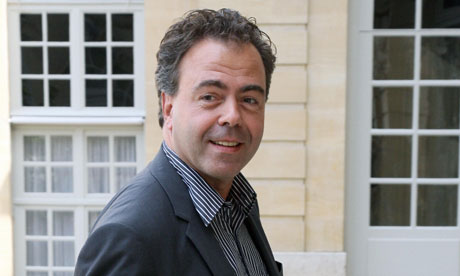
Children could start learning English in France's nursery schools from age three as part of a strategic review of language education launched by education minister Luc Chatel.
Chatel announced last month that he wanted to "reinvent the learning of English" in schools. He said a team of specialists were examining a range of options aimed at boosting young people's skills in English and other foreign languages.
Specialists would investigate starting learning from age three, he said. "We have been experimenting with this and there have been some good results," he said.
He also wants to develop online language learning and to encourage more secondary school children to go on language-study trips to English-speaking countries.
But the minister's commitment to high-quality language teaching has been called into question. As part of cuts to education budgets announced last month, schools are likely to lose up to 1,000 specialist language assistants from classrooms from the start of the next academic year.
According to the Le Monde newspaper, educationalists are sceptical about using computers for language learning from such a young age. "Putting three-year-olds in front of computers?" asked Christian Chevalier, general secretary of the SE-Unsa teachers' union. "We are not opposed to developments in teaching that are useful. But you need a human to impart knowledge. Only a high-quality teacher who can speak English can teach the language," he said.
Thiruvananthapuram: The text book on information and communication technology (ICT) for Kerala's class-nice school students will help them learn audio recording and video editing, an official said on Monday.
The text book, developed by IT@School Project, will be available from the next academic year beginning in a few months' time.
Apart from Malayalam, the textbook will also be made available in English, Tamil and Kannada languages, said K. Anvar Sadath, executive director of IT@School Project.
The union ministry of human resource development and several other states have shown interest in the ICT-enabled education system enabled inKerala.
The IT@School Project is the technology arm of the state education department. It aims to empower students by providing ICT-enabled education from the grass root level.
Sadath said the new ICT text book includes topics on several free software packages such as Audacity, WinFF, which teach students to re-record a poem as needed, re-edit portions if necessary and even give a new background music to selected portions.
"The textbook also teaches how to use handicams available at schools and also ways to create an educational documentary using the videos," said Sadath.
Last year class-eight students were provided with an ICT text book.
"The new textbook for class-nine is designed completely in tune with the national curriculum framework. With a text book planned for class-10 also next year, the shift to ICT enabled education in the state's high schools will be complete," added Sadath.
English is being pushed onto syllabuses in a bid to break with a powerful neighbour to the north
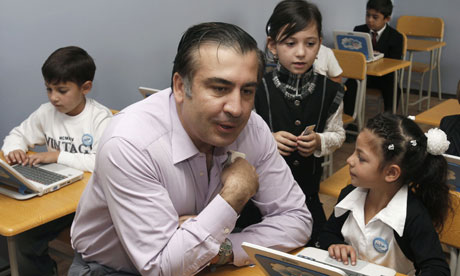
Georgia's President Mikheil Saakashvili launches the country's English language teaching programme at the start of the new school year. Photograph: David Mdzinarishvili/Reuters
With Alexander Pushkin's framed visage on the wall and creased editions of fellow Russian literary giants on dusty shelves, Natela Chokhonelidze's office recalls a very different era at Georgia's state university.
"We once had a staff of 50, and now there are five, because there aren't many students," said the 70-year-old professor emeritus at the university's institute of Russian studies. "Russian language is fading out," she quipped, "with me!"
Chokhonelidze is on the losing side of a deliberate shift in the former Soviet republic as its pro-western leadership tries to supplant Russian with English as the default second language of 21st-century Georgia.
Last month hundreds of native English speakers joined the first day of school as teaching assistants under an ambitious programme to have every child aged five to 16 speak English. English is now compulsory and Russian optional.
The aim appears pragmatic in a globalised world where English dominates and Georgia's investment-driven economy is seeking partners in Turkey and the European Union.
It fits neatly too, however, with President Mikheil Saakashvili's policy of dragging the Caucasus country of 4.5 million people out from Russia's orbit, two years after war shattered already fragile ties between the neighbours.
"We're a free and independent country and our people are free and independent. It's their choice which language to learn," said education minister Dmitry Shashkin, an ethnic Russian, in English.
The government plans to recruit 1,000 native-English speakers by the end of the year on $272 per month, eventually building up to one per school.
English "opens many doors", said Shashkin. "Georgia doesn't have oil, Georgia doesn't have natural gas. The resource we have is our people, the intellectual potential of our country."
On the streets of Georgia's capital Tbilisi, where blue European Union flags flutter outside the parliament building, all Georgians over the age of 40 speak Russian fluently. Shopkeepers are happy to converse in Russian. The younger, educated generation, however, prefer English, and can even bridle if you attempt to talk to them in the language of Georgia's powerful northern neighbour and adversary.
Much of this is generational. Students entering university now were born after the collapse of the Soviet Union in 1991. The influence of western pop culture and the internet is strong.
So too is the fallout from the deterioration in political relations with Russia since Georgia's 2003 Rose Revolution swept aside the ex-Soviet old guard and brought Saakashvili and his team of English-speaking ministers to power.
He set Georgian sights on joining Nato, to the anger of Russia. Political ties collapsed with the 2008 war, when Russia crushed an assault by Georgia's US-trained military on the rebel pro-Russian region of South Ossetia.
Trade links are minimal. Visa requirements and torturous travel routes have strained ties between family and friends.
"Taken in the wider context ... it seems there is a political element behind this," said Shorena Shaverdashvili, editor of Georgian weekly Liberali.
English should be taught, she said, but "Why replace one [language] with the other? This is our neighbourhood and the common language with our neighbours is Russian."
Georgia is now leading the retreat of Russian language in the post-Soviet Union. But Russian remains the lingua franca across much of the former Soviet empire. It is still understood and spoken from Moldova in the west to Kazakhstan and Tajikistan in what was once Soviet central Asia. In the cafes and bars of Dushanbe, Tajikistan's pleasant capital, middle-class Tajiks are more likely to talk to each other in Russian than in Tajik.
In communist times, Russian was taught in Soviet schools as the "language of communication between nationalities". For any ambitious student, especially in more far-flung parts of the Soviet Union, Russian was an essential springboard to a good university education and professional career.
Critics question the wisdom of relegating Russian to a third tier, pointing out that the quality of English teaching in Georgia and other independent post-Soviet countries is often very poor.
At the university, Chokhonelidze laments the passing of an era, and the generations brought up on reading Pushkin, Tolstoy and Dostoyevsky. "I fear in a few years when those grandfathers and grandmothers aren't around, nobody will bother."
The answer, said 20-year-old mathematics student Nugzar Barbakadze, is simple: "I can read Russian books in Georgian."