Showing posts with label Union Minister. Show all posts

Monday, March 7, 2011

Sibal inaugurates E-certificate for UGC-NET qualifying candidates

New Delhi: Union Minister for Human ResourceDevelopment Kapil Sibal on Thursday inaugurated the 'e-certificate' for the University Grants Commission - National Eligibility Test (UGC-NET) qualified candidates.

The minister also released a compendium of UGC schemes. The UGC has initiated steps for online registration of the NET examination so that all the necessary information with regard to the candidates is captured, including their photographs, at the time of registration itself.

The information thus captured is proposed to be used for the award of these e-certificates once the results are announced.

These e-certificates will cut down the time lag for issuing the certificate from 6-8 months to 6 days. Similarly, whenever an institution writes to UGC for verification of authenticity of the NET Certificatepresented by the candidates, the authenticity of thecertificate will now be done within a span of 24 hours as against the earlier 4 months.

The process of issuing the UGC-NET qualificationcertificate to successful candidates normally takes around 6-8 months, a cause of concern both to UGC and to the students.

Also, institutions wrote to UGC for verifying the authenticity of the NET Certificates being presented by the candidates at the time of admission to Ph.D. or at the time ofappointment in a College/University for the teaching assignment. This verification currently takes around 4 months another matter of great concern for all stakeholders.

In the compendium, 63 schemes of the UGC have been synoptically profiled, covering the objectives of each scheme, the criteria for becoming eligible to receive financial assistance from the UGC, the operational tenure of the scheme and the process of selection followed in approving the proposals, and finally the quantum of financial assistance that can be provided to execute the scheme.

The University Grants Commission conducts the national level test, viz-a-viz the National Eligibility Test (NET) twice in a year; in June and December to determine the eligibility for the recruitment of teachers as Assistant Professors in Institutions of Higher Learning and for the award of Junior Research Fellowships (JRFs).

The Test is conducted in 77 subjects at 74 Centres spread across the country. While the examination for the award of JRF is being conducted since 1984, the examination for determining the eligibility for Assistant Professorship is being conducted since 1989.

The number of Fellowships under the NET scheme has been increased from 2,000 to 6,400 per annum since 2010. In June, 2010, 10,433 candidates successfully qualified the NET for Assistant Professorship, including JRF.

Thursday, February 3, 2011

Georgia puts up Russian language barriers in schools


    English is being pushed onto syllabuses in a bid to break with a powerful neighbour to the north
  • georgia schools english
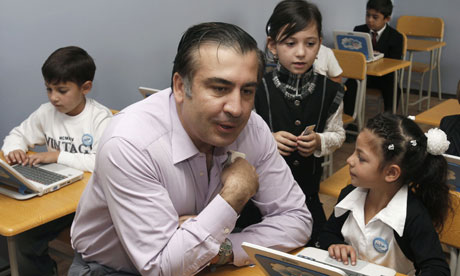
Georgia's President Mikheil Saakashvili launches the country's English language teaching programme at the start of the new school year. Photograph: David Mdzinarishvili/Reuters
With Alexander Pushkin's framed visage on the wall and creased editions of fellow Russian literary giants on dusty shelves, Natela Chokhonelidze's office recalls a very different era at Georgia's state university.
"We once had a staff of 50, and now there are five, because there aren't many students," said the 70-year-old professor emeritus at the university's institute of Russian studies. "Russian language is fading out," she quipped, "with me!"
Chokhonelidze is on the losing side of a deliberate shift in the former Soviet republic as its pro-western leadership tries to supplant Russian with English as the default second language of 21st-century Georgia.
Last month hundreds of native English speakers joined the first day of school as teaching assistants under an ambitious programme to have every child aged five to 16 speak English. English is now compulsory and Russian optional.
The aim appears pragmatic in a globalised world where English dominates and Georgia's investment-driven economy is seeking partners in Turkey and the European Union.
It fits neatly too, however, with President Mikheil Saakashvili's policy of dragging the Caucasus country of 4.5 million people out from Russia's orbit, two years after war shattered already fragile ties between the neighbours.
"We're a free and independent country and our people are free and independent. It's their choice which language to learn," said education minister Dmitry Shashkin, an ethnic Russian, in English.
The government plans to recruit 1,000 native-English speakers by the end of the year on $272 per month, eventually building up to one per school.
English "opens many doors", said Shashkin. "Georgia doesn't have oil, Georgia doesn't have natural gas. The resource we have is our people, the intellectual potential of our country."
On the streets of Georgia's capital Tbilisi, where blue European Union flags flutter outside the parliament building, all Georgians over the age of 40 speak Russian fluently. Shopkeepers are happy to converse in Russian. The younger, educated generation, however, prefer English, and can even bridle if you attempt to talk to them in the language of Georgia's powerful northern neighbour and adversary.
Much of this is generational. Students entering university now were born after the collapse of the Soviet Union in 1991. The influence of western pop culture and the internet is strong.
So too is the fallout from the deterioration in political relations with Russia since Georgia's 2003 Rose Revolution swept aside the ex-Soviet old guard and brought Saakashvili and his team of English-speaking ministers to power.
He set Georgian sights on joining Nato, to the anger of Russia. Political ties collapsed with the 2008 war, when Russia crushed an assault by Georgia's US-trained military on the rebel pro-Russian region of South Ossetia.
Trade links are minimal. Visa requirements and torturous travel routes have strained ties between family and friends.
"Taken in the wider context ... it seems there is a political element behind this," said Shorena Shaverdashvili, editor of Georgian weekly Liberali.
English should be taught, she said, but "Why replace one [language] with the other? This is our neighbourhood and the common language with our neighbours is Russian."
Georgia is now leading the retreat of Russian language in the post-Soviet Union. But Russian remains the lingua franca across much of the former Soviet empire. It is still understood and spoken from Moldova in the west to Kazakhstan and Tajikistan in what was once Soviet central Asia. In the cafes and bars of Dushanbe, Tajikistan's pleasant capital, middle-class Tajiks are more likely to talk to each other in Russian than in Tajik.
In communist times, Russian was taught in Soviet schools as the "language of communication between nationalities". For any ambitious student, especially in more far-flung parts of the Soviet Union, Russian was an essential springboard to a good university education and professional career.
Critics question the wisdom of relegating Russian to a third tier, pointing out that the quality of English teaching in Georgia and other independent post-Soviet countries is often very poor.
At the university, Chokhonelidze laments the passing of an era, and the generations brought up on reading Pushkin, Tolstoy and Dostoyevsky. "I fear in a few years when those grandfathers and grandmothers aren't around, nobody will bother."
The answer, said 20-year-old mathematics student Nugzar Barbakadze, is simple: "I can read Russian books in Georgian."

Thursday, January 20, 2011

Sibal moots institutional framework between NCERT and SCERTs

New Delhi: Union Minister for Human Resource Development (HRD) Kapil Sibal has mooted the framework for an institution that will be set up constituting of the National Council of Educational Research and Training (NCERT) and the State Councils of Educational Research and Training (SCERTs).

This framework could include the Central Board of Secondary Education (CBSE), Council of Boards of School Education (COBSE) and the National Council for Teacher Education (NCTE) as invitees, and would be a mechanism for coordination, continuous flow of information and dialogue.

Speaking at a meeting of the Central and State Regulatory Institutions for School Education, the minister said that the focus of the framework institution would be on improving the quality of education throughout the country.

He also underlined that the effort of the educational administrators and curriculum developers should be to maximize standards rather than settling for minimum standards. He was speaking at a meeting of Central and State Regulatory Institutions for School Education, here today.

The minister stated that as per the National Council for Teacher Education (NCTE) teacher qualification norms under the Right to Education Act, Teacher Eligibility Test (TET) will be an essential qualification.

He said that while the NCTE is developing the standards and benchmarks for this Teacher Eligibility Test, state governments would be responsible for administering these tests and it is the responsibility of the state governments to ensure that these tests conform to high standards.

He further added that the institutional mechanism between NCERT and SCERTs should work towards developing question banks which could be used by states for their Teacher Eligibility Test.

The minister also talked about the development of the National Vocational Qualification Framework (NVQF). He said that "the government has begun a process of series of consultations with different industry groups to facilitate development of vocational curriculum as demanded by the needs/job requirements of these industry groups."

He called upon the state governments to identify skills specific to their states and develop curriculum for these skills.

The NCERT in its presentation, among other things, stated that the government is proposing to set up a 24x7 channel for teaching through information and communications technology (ICT).

The NCERT would be the nodal agency for this channel and the National Institute of Open Schooling (NIOS) and Indira Gandhi National Open University (IGNOU) would be the collaborating agencies.

The target audience for this channel would be school students in the 5-18 years age group, open education students and neo adult literates.

source: http://www.indiaedunews.net/Today/Sibal_moots_institutional_framework_between_NCERT_and_SCERTs_13384/

The Eric Friedheim Library: Events and Classes

Business Affiliate Programs •  Sale •  Personals •  Advertising •  Shopping

LinkWithin

Related Posts Plugin for WordPress, Blogger...