Thursday, February 3, 2011

Georgia puts up Russian language barriers in schools


    English is being pushed onto syllabuses in a bid to break with a powerful neighbour to the north
  • georgia schools english
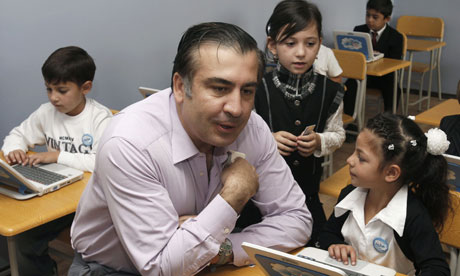
Georgia's President Mikheil Saakashvili launches the country's English language teaching programme at the start of the new school year. Photograph: David Mdzinarishvili/Reuters
With Alexander Pushkin's framed visage on the wall and creased editions of fellow Russian literary giants on dusty shelves, Natela Chokhonelidze's office recalls a very different era at Georgia's state university.
"We once had a staff of 50, and now there are five, because there aren't many students," said the 70-year-old professor emeritus at the university's institute of Russian studies. "Russian language is fading out," she quipped, "with me!"
Chokhonelidze is on the losing side of a deliberate shift in the former Soviet republic as its pro-western leadership tries to supplant Russian with English as the default second language of 21st-century Georgia.
Last month hundreds of native English speakers joined the first day of school as teaching assistants under an ambitious programme to have every child aged five to 16 speak English. English is now compulsory and Russian optional.
The aim appears pragmatic in a globalised world where English dominates and Georgia's investment-driven economy is seeking partners in Turkey and the European Union.
It fits neatly too, however, with President Mikheil Saakashvili's policy of dragging the Caucasus country of 4.5 million people out from Russia's orbit, two years after war shattered already fragile ties between the neighbours.
"We're a free and independent country and our people are free and independent. It's their choice which language to learn," said education minister Dmitry Shashkin, an ethnic Russian, in English.
The government plans to recruit 1,000 native-English speakers by the end of the year on $272 per month, eventually building up to one per school.
English "opens many doors", said Shashkin. "Georgia doesn't have oil, Georgia doesn't have natural gas. The resource we have is our people, the intellectual potential of our country."
On the streets of Georgia's capital Tbilisi, where blue European Union flags flutter outside the parliament building, all Georgians over the age of 40 speak Russian fluently. Shopkeepers are happy to converse in Russian. The younger, educated generation, however, prefer English, and can even bridle if you attempt to talk to them in the language of Georgia's powerful northern neighbour and adversary.
Much of this is generational. Students entering university now were born after the collapse of the Soviet Union in 1991. The influence of western pop culture and the internet is strong.
So too is the fallout from the deterioration in political relations with Russia since Georgia's 2003 Rose Revolution swept aside the ex-Soviet old guard and brought Saakashvili and his team of English-speaking ministers to power.
He set Georgian sights on joining Nato, to the anger of Russia. Political ties collapsed with the 2008 war, when Russia crushed an assault by Georgia's US-trained military on the rebel pro-Russian region of South Ossetia.
Trade links are minimal. Visa requirements and torturous travel routes have strained ties between family and friends.
"Taken in the wider context ... it seems there is a political element behind this," said Shorena Shaverdashvili, editor of Georgian weekly Liberali.
English should be taught, she said, but "Why replace one [language] with the other? This is our neighbourhood and the common language with our neighbours is Russian."
Georgia is now leading the retreat of Russian language in the post-Soviet Union. But Russian remains the lingua franca across much of the former Soviet empire. It is still understood and spoken from Moldova in the west to Kazakhstan and Tajikistan in what was once Soviet central Asia. In the cafes and bars of Dushanbe, Tajikistan's pleasant capital, middle-class Tajiks are more likely to talk to each other in Russian than in Tajik.
In communist times, Russian was taught in Soviet schools as the "language of communication between nationalities". For any ambitious student, especially in more far-flung parts of the Soviet Union, Russian was an essential springboard to a good university education and professional career.
Critics question the wisdom of relegating Russian to a third tier, pointing out that the quality of English teaching in Georgia and other independent post-Soviet countries is often very poor.
At the university, Chokhonelidze laments the passing of an era, and the generations brought up on reading Pushkin, Tolstoy and Dostoyevsky. "I fear in a few years when those grandfathers and grandmothers aren't around, nobody will bother."
The answer, said 20-year-old mathematics student Nugzar Barbakadze, is simple: "I can read Russian books in Georgian."

World education rankings: which country does best at reading, maths and science?


The OECD's comprehensive world education ranking report, PISA, is out. Find out how each country compares

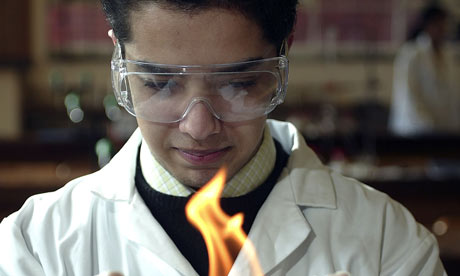
A pupil in a science lesson
World education rankings show how countries do atreading, maths and science. A pupil in a science lesson. Photograph: David Sillitoe/Guardian
The world education rankings from the OECD are out. The UK is slipping down in maths, reading and science, and has been overtaken by Poland and Norway, this major study of 65 countries reveals today.
Around 470,000 15-year-olds across the world sat a numeracy, literacy and science test last year, the results of which inform the latest Pisa study by the Paris-based Organisation for Economic Co-operation and Development (OECD).
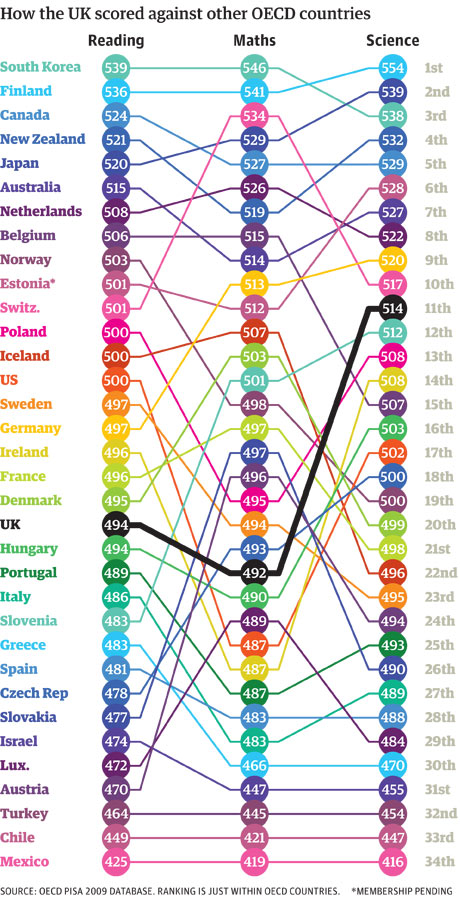
PISA rankings within OECD
PISA rankings within OECD. Illustration: Paul Scruton for the Guardian
The Programme for International Student Assessment (Pisa) is highly respected across the globe, and enables politicians and policy-makers to assess how different country's education systems compare.
It shows the UK's reputation as one of the world's best for education is at risk, and has tumbled several places since 2006.
The UK is ranked 25th for reading, 28th for maths and 16th for science. In 2006, when 57 countries were included in the study, it was placed 17th, 24th and 14th respectively. Poland has stretched ahead of the UK in maths, while Norway is now ranked higher in reading and maths.
Andreas Shleicher, head of the Pisa programme, said the picture for the UK was "stagnant at best". "Many other countries have seen quite significant improvement," he added.

UK seeks to raise language entry levels

Proposals for tougher visa requirements put language skills at centre of bid to reduce bogus foreign students.


uk english students
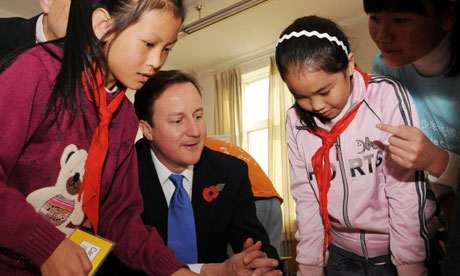
Open for study? Prime minister David Cameron meets schoolchildren in China. Photograph: ANDY RAIN/EPA
UK ministers are expected to put in place tougher English language requirements in a bid to reduce the number of students coming to Britain to study at below degree level.
Proposals to raise minimum English language skills levels were part of a range of options published by the Home Office last month which, if implemented, could see tens of thousands of students from outside the EU turned away.
Two-thirds of the non-EU migrants who enter the UK come on student visas and the government must bring down these numbers if it is to fulfil its pledge to cut net migration from 200,000 to below 100,000 by 2015.
Consultation on the proposals closes at the end of this month, but ministers are expected to move quickly to make changes to the rules for the Tier 4 student visa category.
Setting out the proposals, home secretary Theresa May said: "We want a student visa system which encourages the entry of genuine students coming to study legitimate courses – that means students who are equipped to study their courses."
Under current rules, students studying at below degree level must prove that they are already at level B1 in English. That level, referring to the Common European Framework of Reference, is approximately equivalent to intermediate language skills.
The UK Border Agency, which published the consultation, wants to raise that minimum level to B2, or "upper-intermediate competency", and to extend the requirement to all students, not just those studying at below degree level.
Under the proposals, only results from approved language tests will be accepted as proof of proficiency.
The UKBA consultation document stated: "Raising the language bar will act as evidence of a student's fitness to complete the course in English, as well as assisting with their integration with other students. Secure language testing will ensure that the person applying for entry is the person who sat and passed the language test."
Most UK universities, which already ask foreign students to meet proficiency requirements at or above B2, are unlikely to be affected by the proposals. The UKBA's intended target are private pre-degree-level colleges that have lower entry requirements and less independent scrutiny of language skills.
But the government has shown that it is willing to listen to lobbying from the education sector. Just days after the UKBA consultation was launched, immigration minister Damian Green announced that he was extending the period that English language learners can remain in the country under the student visitor visa from six to 11 months.
Green said the temporary extension, which came into effect at the start of the year, was in response to representation from English language teaching providers who argued that learners would need more time to reach higher minimum levels.
"This concession is intended to create flexibility to allow legitimate English language colleges to continue to offer opportunities to genuine students. I shall monitor closely the practical impact to ensure that it does not become a loophole," he said.
Tony Millns, chief executive of English UK, which represents English language schools, said: "This change will provide a route for English language students who are relative beginners and are likely to need a course longer to reach level B1."

Wednesday, February 2, 2011

9 Distance programmes that assure careers

FOR a long time distance learning institutes were associated with regular courses in Humanities and Social Sciences with a few adventurous ones such as Annamalai venturing into Science streams as well. But in recent years, DL institutions have moved towards courses that have immediate employment potential. Offered in association with either a private institute or a corporation, these programmes have become a rage, though issues of quality, governance, academic control and cost do arise in these cases. But their ability to generate employable graduates is not in question anymore.
BA in Applied Sign Language Studies
University: IGNOU
Duration: 3 years
Fee: Rs. 36,000
Eligibility: English literacy level must be equivalent to IELTS score of 4.5 for writing skills (intermediate level) and an equivalent of IELTS 5.0 for reading skills (upper intermediate level)
Address: Programme Coordinator, BAASLS
IGNOU, Maidan Garhi, New Delhi-110068
Website: www.ignou.ac.in
This programme is jointly offered by IGNOU and University of Central Lancashire, (UCLan), UK, and aims to produce sign language teachers, teacher trainers, literacy support teachers and project workers in the specialised area of sign languages and deaf communities.
The course is taught in Sign Language and English, and is flexible so that students can study a range of modules according to their interest. Focus areas include pedagogical practices in language teaching modules and dissertation modules. The university offers a number of scholarships too.
MCom in Business Policy and Corporate Governance
University: IGNOU
Duration: 2 years
Fee: Rs. 6,000
Eligibility: Graduate in any discipline or equivalent qualifications from a recognised university/ institute and b. Pass in Company Secretaryship executive programme
Address: IGNOU, Maidan Garhi, New Delhi-110068
Website: www.ignou.ac.in
This programme is designed and developed in collaboration with the Institute of Company Secretaries of India, exclusively for the Company Secretaryship professional programme students. Students can simultaneously study this MCom programme along with the Company Secretaryship professional programme offered by ICSI.
The main objective of this programme is to develop skills and competencies of the students in business policy and corporate governance. The programme comprises 12 courses of which IGNOU offers four (which are a part of existing MCom programme) and ICSI offers eight (which are a part of CS professional programme).
MA in Participatory Development
University: IGNOU
Duration: 2 years
Fee: Rs. 25,000
Eligibility: Bachelor’s degree in any discipline
Address: Centre for Extension Education (CEE), IGNOU, Maidan Garhi, New Delhi-110068
Website: www.ignou.ac.in
The programme focuses on understanding poverty and sustainable development. It introduces students to different models of social policy formulations and its relevance to social planning and development. Completion of first, second and third semester makes the student eligible for Advanced Diploma, and on completion of all the four semesters, a Master’s degree is awarded.
Distance delivery includes print materials, audio-visual CDs, guest faculty and engaged communication through web-enabled bulletin board services. On completion the programme makes one eligible to work for developmental institutions and NGOs, amongst others.
MSc in Dietetics and Food Service Management (DFSM)
University:IGNOU
Duration: 2 years
Fee: Rs. 19,900
Eligibility: Graduation in select streams
Address: School of Continuing Education
IGNOU, Maidan Garhi, New Delhi-110068
Website: www.ignou.ac.in
This course is designed to help working professionals like dietitians, nutrition counsellors and food service managers, who want to enhance their career prospects in the healthcare, fitness and hospitality sector. It focuses on areas such as Applied Physiology, Nutritional Biochemistry, Food Safety and Food Microbiology, and provides theoretical and practical guidance on all aspects of dietetics, from promotion of health to management of diseases.
The medium of instruction is English and there is an arrangement for teleconferences and contact sessions. A unique feature of the programme is that one can exit it after one year, having earned a Postgraduate Diploma in Dietetics and Public Nutrition. Contacts classes in select locations supplement the learning process.
MSc in Geoinformatics
Institute: Annamalai University
Duration: 2 years
Fee: Rs. 17,750
Eligibility: A pass in UG degree programmes in Science/ Engineering/ Agriculture
Address: Directorate of Distance Education, Annamalainagar-608002
Website: www.annamalaiuniversity.ac.in
Geoinformatics deals with science infrastructure to address the problems of geography and geosciences. It combines geospatial analysis and modelling, development of geospatial databases, information systems design, human-computer interaction and both wired and wireless networking technologies. Subjects such as Digital Image Processing, Satellite Remote Sensing and Geographical Information System (GIS) are part of the curriculum.
GIS analysis has become an integral part of complex fields such as disaster management, watershed management, environmental assessment, and risk assessment. Students after graduating in Geoinformatics can find opportunities such as the development of in-car navigation systems, automatic vehicle location systems, Geographical mapping and remote sensing, transportation planning and engineering, environmental modeling and analysis, urban planning, telecommunications, agriculture and public health.
BSc in Visual Communication
University: Annamalai University
Duration: 3 years
Fee: Rs. 28,300
Eligibility: Higher Secondary (10+2)
Address: Directorate of Distance Education, Annamalainagar-608002
Website: www.annamalaiuniversity.ac.in
This programme is the first step towards a successful future for those interested in becoming animators, graphic and web designers. Visual communication is the conveyance of ideas and information in forms that can be read or looked upon and primarily associated with two-dimensional images, it includes: art, signs, photography, typography, drawing, graphic design, illustration, colour and electronic resources.
The programme in Visual Communication aims to impart practical training and develop working knowledge in computer for effectively communicating through medium such as Television, Graphics and Animation. Subjects such as Computer Concepts and Office Automation Tools, Photography and Video Editing and Television Production are part of the curriculum. The boom in animation industry has made the programme an attractive destination.
Certificate course in employability skills
Institute: Institute of Management Technology (IMT) in collaboration with National Law University, Jodhpur
Duration: 2 years
Eligibility: Graduate with 50% marks in aggregate.
Fee: Rs.100,000
Address: A-16, Site 3, UPSIDC Industrial Area, Meerut Road, Ghaziabad - 201003
Website: www.imtcdl.ac.in
The boom in the Indian economy has enhanced the need for skilled manpower. In order to supplement the technical skills acquired during graduation or other formal education, NIIT and IGNOU have announced Finishing School Programmes.
Students opting for IGNOU-NIIT programs will get placement support from NIIT. While NIIT will design and develop and market the programmes and carry out the education delivery, IGNOU will approve admission, design curriculum, consolidate results and award degrees. The programmes will be delivered at NIIT premises through qualified instructors.
The course provides knowledge about Workplace Mannerisms, Business Writing and Presentation Skills. It also guides on how to prepare a good résumé and crack the GD (s) and Personal Interview. This programme is also targeted at working professionals and job seekers. At the end of this programme, students would be in a position to apply for Executive Assistants, Office Managers and Personal Secretary, amongst others. It caters to skill development in a hitherto unattended sector which has good potential. Students with a pleasing personality and excellent communication skills stand a good chance of getting real value out of the course.
MS in Cyber Law and Security
Institute: NIIT in collaboration with IGNOU
Duration: 91 hours
Eligibility: Graduates/final year students of all streams
Fee: Rs. 3,500
Address: NIIT Delhi,D-5 South Extension Part II, New Delhi
Website: www.niit.com/Pages/DefaultINDIA.aspx
Recent advancements in IT have revolutionised almost all the arenas of human endeavor. To understand the dynamics of cyber security and cyber law matrix, techno-legal professionals with the blended skills of law and technology are highly required.
The proposed collaborative course of NLU and IMT - CDL aims to develop the skills to tackle cyber security issues with a technological ground. It also aims to provide understanding of national and international regulations and paradigms regarding cyber law.
The proposed programme will have two parts namely (i) Cyber Law and (ii) Cyber Security. A total of 16 courses are offered under this programme with 4 papers in each semester. 8 courses are related to various issues of Cyber Security and remaining 8 courses to Cyber Law. Online classes are conducted for this programme.
MBA in Shipping and Logistics
University: Tamil Nadu Open University
Duration: 2 years
Eligibility: Graduate or Mariners with 6 years experience post 10+2
Fee: Rs. 60,000
Address: Tamil Nadu Open University
Directorate of Technical Education Campus
Guindy, Chennai 600 025
Website: www.tnou.ac.in
This sector-specific management programme aims to equip seafarers (people employed on board ships) seeking a career change to land-based employment in Shipping and Logistics companies. It also targets people working in Shipping and Logistics companies desirous of career advancement and fresh graduates interested in pursuing careers with Shipping and Logistics companies.
The programme aims to equip the students with adequate skills and knowledge in General Management functional areas and in the Shipping and Logistics business sectors. 32 percent of courses in the first year and 52 percent of the courses in the second year are oriented to Shipping and Logistics sector that would help students gain an overall perspective of the sector. The programme would provide the learners knowledge on the various modern Management theories and their applications in the Shipping and Logistics Industry.

source : http://in.education.yahoo.com/news/yeducareers360/9-distance-programmes-that-assure-careers-20110131

Geology, a career for outdoor enthusiasts!

Geology is gaining popularity in line with the growth in the demand for fossil fuel and discovery of new reserves.
Fast Facts
Best Schools: Delhi University, Banaras Hindu University, Jadavpur University, University of Madras, Ranchi University.
Qualification: BSc, MSc in Geology
What you become: Marine geologist, Petrologist, Mineralogist, Geohydrologist, Hydrologist, Paleontologist, Seismologist
Recruiters: Geological Survey of India, Central Ground Water Board, ONGC, Bharat Petroleum Corporation Limited, Mineral Exploration Authority, Indian Space Research Organisation
How do mountains rise? How are rocks created and destroyed? These questions can be answered if we study Geology, a field-oriented, scientific discipline, which investigates the properties of the earth, its substances, shapes, processes and history. Geology is a multi-disciplinary subject, which includes study of minerals (mineralogy), rocks (petrology), the structure of the Earth (structural geology), volcanic phenomena (volcanology), landforms and the processes that produce them (geomorphology and glaciology), study of fossils (paleontology), the development of sedimentary strata (stratigraphy) and the evolution of planetary bodies and their satellites (astrogeology).
By studying the history, composition, changes that occur on the earth, geologists foresee how events, processes of the past influence the future, says Prof. Mallickrarjun Joshi, Professor, Department of Geology, Benaras Hindu University (BHU). A geology class all starts with rocks and minerals, which are not just stones but stories. For instance, the knowledge on the age of the rock would help a student of geology to identify the type of mineral. The study of rocks, minerals, mountains, earthquakes, volcanoes, rivers, glaciers, landslides and floods fall into this broad field.
What a geologist does
A geologist’s job involves two main functions: Exploration and Research. Exploration: Involves detailed identification of structures (mountains, rivers, rocks), investigation of the resources of a region (drilling into the ground to locate water, mineral, energy resources), predict future geologic hazards like earthquakes, floods, landslide.
Research: Compiles the data into a geological map, which shows the distribution and relationship of the properties. It is supplemented by laboratory investigation, where a geologist uses microscopic, electronic equipment and computing techniques to analyse samples collected from the field. After the analysis (which includes calculations) a geologist prepares a report.
A geologist’s work significantly includes - field activity, office-based data processing, report writing and project planning. The scope of the job depends on the work area of the company or organization, you work for. For instance, Pranjal who works as a Geologist with ONGC’s Oil Exploratory Division in Gujarat monitors the oil wells to locate how much oil can be extracted for developing process.
According to Soma Sengupta, Senior Advisor (Geology) at Directorate General of Hydrocarbons, majority of the geologists working in the petroleum and oil industries are involved in both exploratory and laboratory work. “Working in the field may mean spending long hours outdoors, doing exploration, surveying and production,” she said.
Entering the field
To kickstart your career as a geologist you must have completed an MSc in Geology. Most universities across the country offer a Bachelor’s, Master’s and PhDs in Geology. You must have completed 10+2 in Science to enrol for a BSc in Geology.
“A Master’s degree is enough for any entry-level positions. But an advanced degree like PhD will help you enter colleges to teach,” says Joshi.
BSc
A BSc focuses on the basic concepts of Petroleum Geology, Marine Geology etc.
MSc
It comprises both pure and applied geology, which focuses on the advanced learning of the fields. It builds upon the foundation laid during a BSc, by building a strong theoretical and practical framework. Writing a dissertation is one of the general requirements. According to Amit Sarma who works in the petroleum industry as a geologist in Noida, the theory learnt during his MSc helped him to put concepts into practice.
Further specialisation
After MSc, one can also opt for MSc (Tech)/MTech for specialisation in Geotechnical and Geo-environmental engineering etc., which are parts of Civil Engineering field. In order to be eligible, one must have a GATE score.
An added advantage for these students is that all institutes offer scholarships of at least Rs. 8,000 per month with a contingency fund of Rs. 10,000 per annum. Due to the increase in the demand of oil and natural gas and also because of new findings of reserves, the most recent trend spotted in many colleges is the rush towards taking up MSc Petroleum Geology/MTech Petroleum Exploration.
Qualities required for the job
* Ability to visualise
* Good scientific/technical skills
* Audacious as an explorer
* Physical fitness
* Ability to interpret statistical and graphical information
* Attention to detail
* Report-writing skills
Field trips
Since geology is related to environment, a large portion is taught outdoors. So, field work becomes an integral part of all degree programmes. It may include collection of geologic data, constructing a measured section, interpreting geologic structures and geologic mapping.
Geology and the environment
Geologists have an important role in preserving and keeping the environment clean as they assess natural disasters and its effects. Their activities include - monitoring waste disposal sites, preserving water supplies and minimising the threat to communities at risk from geologic hazards like earthquakes, landslides, volcanoes and tsunamis. Geological maps are important inputs for the generation of hazard maps. It helps the mitigation team to engage in disaster management in an efficient manner.
Geology meets engineering Geologists play an inevitable role in engineering projects. The meeting point of engineers and geologist is in the irrigation, nuclear power and communication projects like bridges, tunnels, roads etc. Every civil engineer has to get well-equipped with geology. According to Dr K.S Rao, Professor, IIT, Delhi, there is a wide application of geological principles in the areas like Geotechnical & Geoenvironmental, Hydraulics, Structure and Transportation Engineering. Prior to any building construction, an engineer has to determine the properties of soil. “To determine the stability of the structure, the engineers work closely with geologists to identify the type of bedrock at building sites,” he stressed.
Opportunities galore
Geology prepares you to be part of varied areas, right from resource management and environmental protection to mineral and oil exploration.
They can specialise in innumerable fields. A geologist can work in engineering and consulting firms, government agencies, mining companies, petroleum companies, museums. The UPSC conducts exams for placement in GSI, Central Ground Water Board etc. They also have an option to take up IAS/Forestry Service. PSUs like ONGC, Hindustan Zinc Ltd conducts All India Entrance exam for hiring Geologists.
With an advanced degree, a geologist will qualify for supervisory/ research/ teaching positions through NET in Universities or institutes.
Demand for geologists often mirror the price of geological commodities such as fuels, metals and construction materials. As rise in international oil price directly relates to Geology. The oil companies become more viable for exploration and this creates a major demand for Geologists in the market.
Kinds of geologists
Marine Geologist
Studies marine environment. With the help of remote sensing they locate old rocks and vegetations and effects on sea and atmosphere.
Petrologist
Conducts explorations for new oil and gas fields both the onshore and offshore activity. All types of survey like geophysical and seismic surveys are carried out before drilling.
Mineralogist
Identifies useful mineral in rocks and sea beds. It’s mostly work in the underground.
Geohydrologist
Locates and assesses sources of water and also find threats which can pollute the water.
Hydrologist
Studies underground sources of water and all related parameters to it like infiltration and pollution threats.
Paleontologist
Works with fossils (dead remain of creatures and plants). They estimate their age and try to find how the earth was at that time and what lead to their deaths.
Seismologist
Works with movement of Earth’s tectonic plates, which causes earthquakes.
Surveyor
Collects data about land and sea and maintain a database and keep monitoring the changes in data with past and present values.
They hire geologists
* Geological Survey of India (GSI)
* Central Ground Water Board (CGWB)
* Directorate of Geology and Mining (DGM)
* Indian Bureau of Mines (IBM)
* Defense Research and Development Organisation (DRDO)
* Indian Space Research Organisation (ISRO)
* National Geophysical Institute (NGRI)
* Wadia Institute of Himalayan Geology, Dehradun
* Bhabha Atomic Research Centre (BARC)
Public Sector Undertakings * Oil & Natural Gas Corporation Ltd. (ONGC)
* National Hydro Power Corporation (NHPC)
* National Thermal Power Corporation (NTPC)
* Minerals and Metals Trading Corporation (MMTC)
* National Remote Sensing Agency (NRSA)
* State Mining Corporation (SMC)
* National Mineral Development Corporation (NMDC)
* NALCO
* Hindustan Zinc Limited
* Bharat Petroleum Corporation Limited (BPCL)
* Theri Hydro Development Corporation (THDC)
* Mineral Exploration Authority Private sector companies
* Broken Hill
* Rio Tinot
* De Beers
* Cairn Energy
* Reliance Energy
* Shell
* Service providers - Schlumberger, HLS
Money talk
Government jobs (GSI, CGWB) offers you a decent living style, while public sector (ONGC, HPCL, IOC ) offers handsome salary with good perks and better working conditions.
In both the private and public sector, a fresher with an MSc in Geology can expect a salary between Rs. 25,000-38,000. It will vary also based on the location of your work (metropolitan cities, areas prone to harsh weather conditions etc).
Opportunities abroad Besides the USA, Australia, Canada, the need for geologists is rising in developing countries. Indonesia, Malaysia, Saudi Arabia, UAE, Kuwait, India, Vietnam, Thailand, Afghanistan, Bangladesh and Pakistan require geologists for civil works such as the construction of highways, airports, dams, pipelines etc. “The Middle East, the goldmine for oil, is a paradise for geologists,” says Amit.
The flipside As a field geologist you may be placed in situations that will test you in every possible way. Be prepared to work in remote terrains and travel widely as project requirements dictate. There are instances when you might get dehydrated or injured, and most of the time you are not close to the city where you can get aid. Also, working in vulnerable areas (earthquake, flood prone) could be dangerous if he/she is not prepared for it. A geologist has to cope with potential problems which may occur during the construction of tunnels, dams and other gigantic projects. In the tunnels, inaccessibility to proper ventilation, radio connections, traffic lights would lead to accidents.
Filling the jobs in offshore oil fields is proving to be a major challenge. There are several reasons for reluctance: Not many people are willing to live in the middle of the ocean on an oil rig, extremes of temperature - either extremely cold (most deep ocean oil rigs) or extremely hot, sometimes both. If all these pitfalls do not scare you too much, then the field becons you with open arms.

source : http://in.education.yahoo.com/news/yeducareers360/geology-career-outdoor-enthusiasts-20110131

India's Best Student: Dr. Manmohan Singh

The Prime Minister stood first in class throughout his academic life.
Whenever he was asked for the secret of his professional success Prime Minister Manmohan Singh would say only one thing, “I am what I am because of my education.”
He has often thanked his family for ensuring that he went right up to college and then had opportunities to win many scholarships that finally helped him get a PhD from Oxford University.
Manmohan Singh was born into a family of modest means in the village of Gah in Pakistan. For the first 12 years of his life he lived there, a village which had no electricity, no school, no hospital, no piped drinking water.
He walked for miles every day to school and studied at night in the dim light of a kerosene lamp. When asked once why he had poor eyesight he confessed that it was because he had spent hours reading books in that dim light.
It was his hard work that enabled him to finish his schooling and attend college in Amritsar, where he lived after the Partition. He then won a scholarship to go to Cambridge University in England to do his Master’s in Economics. Another scholarship helped him complete his PhD.
He won the coveted Adam Smith Prize in Economics for his outstanding academic record. He always stood first and was a brilliant student.
For all his brilliance, he was a very shy boy. He once told Mark Tully, the famous BBC correspondent in India, that throughout his stay in Cambridge he used to bathe with cold water because the moment hot water was available in the hostel all the other students would come in to bathe and he felt shy to show them his long hair.
As the only Sikh student in the hostel he felt inhibited to remove his turban in front of others. It is this shy boy who became the darling of his teachers because he was such a good student.
He returned to India to teach at his college in Amritsar. One day, his neighbour, renowned writer Mulk Raj Anand, took him to meet Prime Minister Jawaharlal Nehru and Panditji asked him to join the government. But he had a commitment to teach at the college and so he could not accept that offer.
Later, when he was working at the United Nations under the famous economist Raul Prebisch, he got an offer to join Delhi School of Economics as a lecturer. He immediately accepted that invitation and decided to return to India. Dr. Prebisch was shocked. So many brilliant economists would be delighted to get a UN job and this young man was giving it up to teach in India? “You are being foolish,” Prebisch told Manmohan Singh, adding, “But, sometimes in life it is wise to be foolish!”
Manmohan Singh returned home first to teach and then to work in the Government.
He has held every important job in the field of economic policy making in India: Chief Economic Advisor to Government of India, Finance Secretary, Governor, Reserve Bank of India, Deputy Chairman, Planning Commission, Union Finance Minister and now Prime Minister.
In 2005 when he visited Kaula Lumpur for the India-ASEAN Summit he was introduced at the ASEAN Business Forum meeting as “the world’s most qualified Head of Government”!
That is what makes us all proud. No country in the world has a more qualified head of government and India has never had such a highly qualified Prime Minister. Manmohan Singh’s life is a record of excellence and of merit being rewarded. His life will always be an inspiration to young people who want to work hard and achieve something based on their learning.
No rich parents, no influential uncles, no wealth, no inheritance, no one to pull strings and ‘put in a word’ – it was always his merit, his hard work, his honesty, his intelligence and, above all, his deep love for India that energised him. Every young Indian should feel inspired by the life of Manmohan Singh!
Sanjaya Baru served as media advisor to Prime Minister Manmohan Singh from 2004 to 2008, and is currently Editor at Business Standard.


India's best students who became CEOs

NARAYAN MURTHY
As a boy, Nagavara Ramarao Narayana Murthy was someone who could easily go unnoticed in a crowd. He was short, but sharp. Often, his seniors in school came to him for solving Science problems.
Murthy came from a lower middle class, Brahmin family from Mysore. His father, a school teacher, was fond of English literature. And like all the boys of his class, he too had dreams of going to IIT. So he worked hard, studied in the shade of boulders close to Chamundi hills, and helped many in his class to prepare for the entrance exam.
Murthy wasn’t surprised when he got through. When he broke the news of his success to his father, it is said his words were: ‘Anna, I have passed the exam…I want to join IIT.” Proud he was of his son’s achievement but he couldn’t afford the fees and so Murthy had to relinquish his IIT dreams. Murthy stayed back in Mysore. When asked about his decision to stay back, he said to his friends, "It is not the institution but you alone who can change your life with hard work".
He lived up to his own words. Several years afterwards, Narayana Murthy revolutionised India’s software industry by founding Infosys. And this has made him the icon of middle class dreams. He redefined India in the eyes world. India was no longer a third world country, but a fast developing nation. In the process, he promoted thousands of young, creative Indian minds to the world and made Infosys and India a hub of talent.
It is known to the world that he founded Infosys along with six others with just a few thousand rupees which his wife, Sudha Murthy gave. It was an incredible risk to take, but Murthy knew it was going to work, just as he knew he would get through IIT. Which he did, eventually. After Murthy graduated from the National Institute of Engineering, Mysore, he joined IIT, Kanpur.
Thanks to IT and its development, the little known romance of Murthy and Sudha Kulkarni is talked about everywhere. It is hard to believe reading from Sudha’s account of an introvert, quiet Murthy, that he is the same person to have revolutionised the IT industry.
When Murthy was asked by Sudha’s father about his ambitions, he said he wanted to become a politician in the communist party and wanted to open an orphanage.
While he has opened several orphanages since, his dream of becoming a politician still remains unfulfilled. After retiring from Infosys, Murthy was hoping to become President of India after the term of Dr. Abdul Kalam. Even though he denied having political ambitions, his supporters would like to see him on the throne.
Our Mysore Murthy is, no doubt, a visionary who has ignited millions of young minds.
Education
B E (1967)
MTech (1969)
Honours and Awards
Padma Vibushan- 2008
Officer of the Legion of Honor- 2008
World Entrepreneur of the Year- 2003
Business India’s “Businessman of the Year- 1999
JRD Tata Corporate Leadership Award- 1996-97
INDRA NOOYI
Chairman & CEO, PepsiCo
Chairman of PepsiCo's Board of Directors, Indra is the highest-ranking Indian-born woman in corporate America, and she attributes much of her success to her upbringing in India. "Being a woman and being foreign-born, you've got to be smarter than anyone else," says Nooyi, who often dons a sari at PepsiCo events.
Education
She completed schooling at Holy Angels AIHSS, Chennai, has a BSc (Chemistry) from Madras Christian College in 1974 and a PGDM from IIM Calcutta. In 1978, Nooyi earned a Master's degree in Public and Private Management from Yale School of Management. At Yale, she worked as a receptionist from midnight to 5 a.m. to earn some money.
Career graph
Starting her career in India, Nooyi held different positions at Johnson & Johnson and textile firm Mettur Beardsell. In the US, Nooyi worked with BCG, Motorola and ABB. Nooyi joined PepsiCo in 1994, and became chairperson in 2007.
Childhood memories
As a child, Indra’s grandfather insisted on academic excellence from his grandchildren. According to Indra, when she did not figure in the top three ranks in class, she preferred to throw herself under a bus than face her grandfather.
Awards
2007, Padma Bhushan
2008 Elected as Fellow, American Academy of Arts and Sciences
ARUN SARIN
Former CEO, Vodafone
Born on October 21, 1954 at Panchmari, Madhya Pradesh, Sarin was an academically bright student. He was equally good at sports like field hockey, boxing and various extracurricular activities. He wanted to follow his father's footsteps into the military by pursuing a career as a pilot, but when his mom protested, he applied and was accepted at IIT, Kharagpur.
He graduated from the IIT in 1975 with a Bachelor of Science degree in engineering in the top 10 percent of his class and received the BC Roy gold medal for academic excellence. He received a full scholarship to the University of California, Berkeley, Graduate College of Engineering.
In the year 2003, Sarin became the Chief Executive Officer of Vodafone. When he resigned in 2008 from his post Vodafone was the world's largest mobile phone company by revenue. It was the firm’s large market presence in India that catapulted Sarin into the limelight. Currently he serves on the boards of Cisco and Safeway, Inc.
Academics
BTech (IIT)
MBA (Haas UC,Berkeley)
Awards
University of California at Berkeley, Haas School Business Leader of Year- 2002
University of California Trust (UK) Award- 2003
Born in Nagpur, Pandit was the Citigroup’s youngest CEO when he took over in 2007. The first Indian to achieve this feat, the job was touted as the toughest in the world due to the company’s poor performance.
A brilliant boy in school, he moved to US when he was 16. After finishing his Master’s in electrical engineering and MBA from Columbia University, he was determined to get a PhD in a different subject. In those days, students preferred to either study medicine or engineering. And that was the time when his guide advised him to take up finance, as it was a good field. He followed the advice, and switched to finance.
For a brief span, he taught at Indiana University Bloomington, Columbia’s Business School. He stepped into the corporate world in 1994, as a head of Morgan Stanley. His administrative and technical skills, plus an ability to make himself indispensable to bosses like John J. Mack and Phillip J. Purcell, fuelled his career at Morgan Stanley, where he became the president. He dealt with the Institutional Securities Division, Worldwide Institutional Equities Division. For him, this was an interesting area to work on
“To do well you have to put a lot of yourself into it.”
BS, Electrical Engineering, Columbia University (1976)
MS, Columbia University (1977)
MBA, Columbia Business School, Columbia University (1980)
PhD, Columbia Business School, Columbia University (1986)
SABEER BHATIA
Pioneer of web-based e-mail
Sabeer Bhatia has done the unconventional ever since he decided to study abroad at the age of 19; two years into undergraduate education at the Birla Institute of Technology and Science, he qualified for a transfer scholarship at Caltech, considered to be the world's most competitive scholarship. After graduating from Caltech in 1989, he pursued an MS in Electrical Engineering at Stanford University.
At the age of 27, Bhatia was no longer interested in working for others, and together with Smith, began chasing what many people in Silicon Valley deemed a “crazy idea” – a free e-mail service. They raised about $300,000 for their venture - Hotmail. Within a year, Hotmail had one million subscribers. So revolutionary was it that Microsoft bought it for $400 million after 18 months.
Did you know?
* He was rejected by 20 venture capitalists before Draper Fisher Juvetson bought his idea.
* The original spelling was HoTMaiL
Award
TR100 by the MIT, given to 100 young innovators who are expected to have the greatest impact on technology.
Qualifications
BTech, BITS Pilani
BSc(Honours) California Institute of Technology, US
MS Electrical Engineering (Stanford)

The Eric Friedheim Library: Events and Classes

Business Affiliate Programs •  Sale •  Personals •  Advertising •  Shopping

LinkWithin

Related Posts Plugin for WordPress, Blogger...