Showing posts with label Britain. Show all posts

Wednesday, April 13, 2011

France, Britain say NATO must step up Libya bombing

The criticism by London and Paris followed new shelling of Misrata on Monday and the collapse of an African Union peace initiative

France and Britain, who first launched air attacks on Libya in coalition with the United States, said on Tuesday NATO must step up bombing of Moammar Gadhafi’s heavy weapons to protect civilians.

NATO took over air operations from the three nations on 31 March but heavy government bombardment of the besieged western city of Misrata has continued unabated with hundreds of civilians reported killed.

The criticism by London and Paris followed new shelling of Misrata on Monday and the collapse of an African Union (A U)peace initiative.

Echoing rebel complaints, Juppe told France Info radio, “It’s not enough.”

He said NATO must stop Gadhafi shelling civilians and take out heavy weapons bombarding Misrata.

British foreign secretary William Hague also said NATO must intensify attacks, calling on other alliance countries to match London’s supply of extra ground attack aircraft in Libya.

NATO, which stepped up air strikes around Misrata and the eastern battlefront city of Ajdabiyah at the weekend under a U N mandate to protect civilians, rejected the criticism.

“NATO is conducting its military operations in Libya with vigour within the current mandate. The pace of the operations is determined by the need to protect the population,” it said.

Libyan state television said on Tuesday a NATO strike on the town of Kikla, south of Tripoli, had killed civilians and members of the police force. It did not give details.

Peace talks fail

The spat within the alliance came after heavy shelling and street fighting in the coastal city of Misrata on Monday where Human Rights Watch says at least 250 people, mostly civilians, have died.

Libyan rebels rejected an African Union peace plan on Monday because it did not include the removal of Gadhafi, who they accused of indiscriminate attacks on his own people.

French President Nicolas Sarkozy, hailed as a hero by the rebels, led calls for military intervention in Libya and his warplanes were the first to attack Gadhafi’s forces.

In a barbed reference to the NATO takeover, Juppe added: “NATO must play its role fully. It wanted to take the lead in operations, we accepted that.”

NATO is unpopular among many insurgents, both because they believe it initially reacted slowly to government attacks and because it has killed almost 20 rebels in two mistaken bombings. Although they have recently praised the alliance after its attacks helped break a major government assault on Ajdabiyah, many of the rebels in the field still hailed Sarkozy. The rebels took up position about 40 km west of Ajdabiyah on Tuesday after clashes on Monday that left at least three of their fighters dead in a rocket attack.

There was no sign of fighting on Tuesday between Ajdabiyah and the oil port of Brega where the eastern front has see-sawed between the combatants for weeks.

The Red Cross said it would send a team to Misrata to help civilians trapped by fighting.

Rebel leader Mustafa Abdel Jalil said after talks with an African peace mission in rebel-held Benghazi on Monday:

“The African Union initiative does not include the departure of Gadhafi and his sons from the Libyan political scene, therefore it is outdated.”

The AU said in a statement it would continue the mission.

Gadhafi’s son Saif ruled out his father stepping down, calling the idea ridiculous.

Amnesty International on Tuesday accused Gadhafi forces of executing prisoners, killing protesters and attacking refugees.

Scorn
Rebels in Misrata, their last major bastion in western Libya and under siege for six weeks, scorned reports that Gadhafi had accepted a ceasefire, saying they were fighting house-to-house battles with his forces.

Rebels said that Gadhafi’s forces had intensified the assault, for the first time firing truck-mounted, Russian-made Grad rockets into the city, where conditions for civilians are said to be desperate.

NATO attacks outside Ajdabiyah on Sunday helped break the biggest assault by Gadhafi’s forces on the eastern front for at least a week. The town is the gateway to the rebel stronghold of Benghazi 150 km north up the Mediterranean coast.

Gadhafi’s former foreign minister Moussa Koussa, speaking in Britain where he fled in March, called on “everybody, all the parties, to work to avoid taking Libya into a civil war”.

“This will lead to bloodshed and make Libya a new Somalia,” he told the BBC. “More than that we refuse to divide Libya. The unity of Libya is essential to any solution and any settlement in Libya.”

Thursday, April 7, 2011

Cameron's multi-million gamble to win Pakistani minds

Prime minister reveals willingness to work with spy agencies but urges Pakistan to 'make its wealthy pay more tax'
David Cameron has taken a calculated and expensive diplomatic gamble by agreeing to put his faith in the Pakistani security services to help Britain leave Afghanistan, in the hope of preventing the export of terrorism to Britain.

Nearly half of the terrorist plots against Britain come from Pakistan's lawless north-west frontiers.

On a visit to Islamabad, Cameron promised £650m in aid to fund 4 million school places, 90,000 teachers, and refurbishment of 8,000 schools, arguing that education is the best antidote to terror. Pakistan is now the largest beneficiary of UK aid.

Cameron said he could justify the move domestically only if the Pakistani elite paid more taxes. He said bluntly, in a speech, that Pakistan suffered from "weaknesses in terms of government capacity and waste".

But he revealed a new willingness to work with Pakistani intelligence agencies to secure a political settlement in Afghanistan before Britain leaves in 2015.

A year ago, Cameron put UK-Pakistan relations in deep-freeze by criticising the Pakistanis for facing both ways in the fight against terror.

On Tuesday he talked of a fresh start and a new era of co-operation.

British officials say they are now convinced that the growing internal Islamist terrorist threat inside the country has caused the intelligence service, the ISI, to take a tougher role in combating the Taliban and al-Qaida inside Pakistan. British officials said the Pakistani prime minister, Yusuf Raza Gilani, and the president, Asif Ali Zardari, recognised they were involved in "an existential battle" with terrorists.

During his one-day visit, Cameron offered the president unprecedented intelligence co-operation and agreed to set up a joint "centre of excellence" in Pakistan to exchange knowledge on improvised explosive devices.

He also sought to reassure his hosts that he does not see India as Britain's preferred partner in the region. He set a goal of Anglo-Pakistani trade rising from £1.9 bn to £2.5bn by 2015.

In a sign of the importance of the trip to UK national security, Cameron was accompanied by Sir Peter Ricketts, the national security adviser, Sir David Richards, the chief of the defence staff, and Sir John Sawers, head of MI6. The three were in Islamabad only a month ago to prepare the ground for what is being billed as an "enhanced security dialogue". The aim was to build a less transactional relationship, officials said, and to work on the basis of broader, long-term trust.

At a joint press conference, Gilani said: "I want to assure you that Pakistan has the resolve and the commitment to fight against extremism and terrorism. We've paid a heavy price for that."

He pointed out that 30,000 civilians had been killed and a similar number disabled.

He said: "The political leadership has been targeted. The bombs have gone off in girls' schools, hospitals, the malls, the police stations and even in the intelligence service headquarters."

Cameron praised his hosts: "What you see in Pakistan is a huge fight by the government taking place against terrorism."

He defended the size of the projected aid package, saying he would "struggle to find an example of a country" whose progress and success were more in Britain's national interest than were those of Pakistan.

But, unusually, he challenged Pakistan by pointing out that it currently spends only 1.5% of national income on education, and has one of the lowest tax revenues, relative to GDP, of any country in the world.

"You are not raising the resources necessary to pay for things that a modern state and people require," he said. "Too few people pay tax. Too many of your richest people are getting away without paying much tax at all. And that's not fair." British officials indicated that they had asked the Pakistan military as diplomatically as possible when it planned to enter North Waziristan, the tribal heartland and sanctuary from which many terrorist groups operate.

British intelligence and the CIA consider the region to be the place where suicide bombings and cross-border attacks originate.

Cameron made a partial reference in his speech, saying: "Neither the Pakistan army nor Nato forces must ever tolerate sanctuaries for people plotting violence."

The Pakistani army has suffered big losses as a result of clearing out other federally administered tribal areas, and seems to be holding back from tackling North Waziristan, partly due to a peace deal having been struck.

Pakistani troops moved into South Waziristan in 2009. Pakistan says it lacks military capacity to lead an assault on a mountainous area that could lead to a mass exodus of refugees.

In the absence of troops on the ground, Britain supports what it sees as the highly effective use of US unmanned drones to bomb terrorist targets in the area, a practice that Pakistani politicians regularly denounce as being counter-productive and in breach of their sovereignty, and leading to the slaughter of innocent tribal elders. Only last week, Pakistan pulled out of tripartite talks on Afghanistan in anger at the US attacks.

Since 2007, about 164 drone strikes have been carried out, killing almost 1,000 militants.

• This article was amended on 6 April 2011. The original reported the promised education-aid total as £950m. This figure was provisionally reduced after the Guardian was contacted by the Department for International Development. Further clarification is being sought. The original article also said that the aid package included funding for 8,000 teachers. This has been corrected.


Tuesday, March 22, 2011

GLOBAL: What international students want to study

Predicting where future international students will come from and what subjects they go abroad to study has become a mini-industry in receiving countries such as Britain and Australia, where some courses are highly dependent on overseas student fees.

Delegates and experts at the British Council's Going Global conference, held in Hong Kong from 11-12 March, agreed that demand for overseas courses from Asian students will carry on rising.

"Overall demand for international education will continue to grow in the low single digits in the next decade," said Tony Pollock (pictured), Chief Executive of IDP Education, an international student placement service.

However, subject choices may be changing as sending countries like China and India become more affluent, students from Singapore prefer to study at their own excellent universities and Malaysia reduces the number of government scholarships for students on expensive overseas courses.

Medicine and related courses in the West have long been popular with students from India, Malaysia and Hong Kong, while business-related degrees and engineering have been the top choice for students from China, Taiwan and Vietnam.

This is according to a survey of 5,000 prospective international students in 14 countries by Hotcourses, a web-based company that advises students on course choice internationally. 

Students from Pakistan are looking for high quality courses in engineering and technology, and Indonesian students are looking at the natural sciences. 

South Korean students, on the other hand, go abroad to study creative arts and design, while students from India and Malaysia are interested in social sciences and communications, said Mike Elms, Chief Executive of Hotcourses. 

However, patterns are changing in key markets such as China, which last year sent 440,000 students to study abroad, overtaking India as the top sending country.

Prospective students from major Chinese cities may be broadening out the subjects they want to study abroad, according to research by the British Council - information which could also be important for decisions by a number newly emerging regional higher educational hubs on what courses to offer to attract international students. 

The British Council's Education Intelligence Unit research into prospective students' intentions in the coming years found that there have been shifts in the most popular subjects chosen for study in the UK in the last two to three years. 

Students from China are still most likely to study business administration and engineering and technology at overseas universities, but growth in the number of students selecting these subjects is slowing while students from China wanting to study mass communication and documentation, and creative arts and design, has shown much bigger growth. 

"We were trying to capture the student decision-making process before the student embarks on a course," said Janet Illieva, head of research at the British Council in Hong Kong. "For China we have seen decreased demand for engineering."

"There has been a shift in demand towards non-traditional subjects in China at the city level," she said. This was most evident in large cities such as Beijing and Shanghai. "We think this is because of the rise in the middle class in these cities. While in the medium-sized cities, there is definitely a rise in those who say they want to study engineering." 

For example, one in four prospective international students in the city of Shenyang want to pursue engineering. In Nanjing, Xi'an and Chengdu the rise was 17% to 18%, taking over where Beijing was a decade ago. These are also cities where there has been a rise in heavy industry and manufacturing, Illieva said.

Students from China saying they want to study mass communication has risen by 81% since 2008, a possible reflection of the burgeoning use of the internet. Prospective Chinese students wanting to study creative arts has risen by 54% during the same period, compared to 25% to 29% growth for business and engineering. Architecture, building and planning has seen 35% growth in interest from China in the last two years. 

Mass communication has soared to become the third most popular choice for Chinese students wanting to study overseas, rising from 8th most popular in 2006-07. Creative arts has risen to fifth place behind social studies compared to ninth place in 2006-07.

The findings have implications for universities hoping to replace declining applications at home with students from overseas, particularly in science and engineering. 

But Hotcourses' Mike Elms said the key motivator for students looking for courses abroad is "to get a better education. They want a higher quality course than is available to them in their own (education) market," he said.

Saturday, February 26, 2011

Obama to discuss Libya sanctions with France,Britian

Washington: President Barack Obama will Thursday discuss punitive measures against Libya, including sanctions, with British Prime Minister David Cameron and French President Nicolas Sarkozy, the White House said.

“They will be discussing Libya and they will be discussing different options that we can take,” White House spokesman Jay Carney said, saying the calls were due to take place later in the day.

“I am sure, broadly speaking, our options will be discussed,” he said, though he declined to detail exact steps Washington wanted to see taken, amid calls for sanctions and the establishment of a “no fly” zone over Libya.

“I am not ruling anything out,” Carney said, though acknowledged “sanctions are something we are looking at.”

“Exploring the options means just that,” Carney said, when asked whether the Pentagon was laying plans to enforce a “no fly zone” to protect civilians in Libya.

Thursday, February 3, 2011

UK seeks to raise language entry levels

Proposals for tougher visa requirements put language skills at centre of bid to reduce bogus foreign students.


uk english students
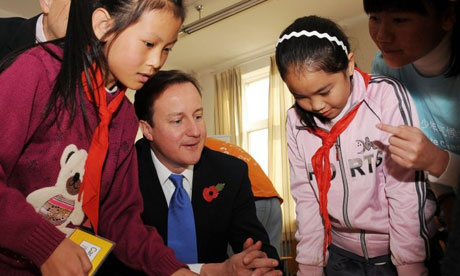
Open for study? Prime minister David Cameron meets schoolchildren in China. Photograph: ANDY RAIN/EPA
UK ministers are expected to put in place tougher English language requirements in a bid to reduce the number of students coming to Britain to study at below degree level.
Proposals to raise minimum English language skills levels were part of a range of options published by the Home Office last month which, if implemented, could see tens of thousands of students from outside the EU turned away.
Two-thirds of the non-EU migrants who enter the UK come on student visas and the government must bring down these numbers if it is to fulfil its pledge to cut net migration from 200,000 to below 100,000 by 2015.
Consultation on the proposals closes at the end of this month, but ministers are expected to move quickly to make changes to the rules for the Tier 4 student visa category.
Setting out the proposals, home secretary Theresa May said: "We want a student visa system which encourages the entry of genuine students coming to study legitimate courses – that means students who are equipped to study their courses."
Under current rules, students studying at below degree level must prove that they are already at level B1 in English. That level, referring to the Common European Framework of Reference, is approximately equivalent to intermediate language skills.
The UK Border Agency, which published the consultation, wants to raise that minimum level to B2, or "upper-intermediate competency", and to extend the requirement to all students, not just those studying at below degree level.
Under the proposals, only results from approved language tests will be accepted as proof of proficiency.
The UKBA consultation document stated: "Raising the language bar will act as evidence of a student's fitness to complete the course in English, as well as assisting with their integration with other students. Secure language testing will ensure that the person applying for entry is the person who sat and passed the language test."
Most UK universities, which already ask foreign students to meet proficiency requirements at or above B2, are unlikely to be affected by the proposals. The UKBA's intended target are private pre-degree-level colleges that have lower entry requirements and less independent scrutiny of language skills.
But the government has shown that it is willing to listen to lobbying from the education sector. Just days after the UKBA consultation was launched, immigration minister Damian Green announced that he was extending the period that English language learners can remain in the country under the student visitor visa from six to 11 months.
Green said the temporary extension, which came into effect at the start of the year, was in response to representation from English language teaching providers who argued that learners would need more time to reach higher minimum levels.
"This concession is intended to create flexibility to allow legitimate English language colleges to continue to offer opportunities to genuine students. I shall monitor closely the practical impact to ensure that it does not become a loophole," he said.
Tony Millns, chief executive of English UK, which represents English language schools, said: "This change will provide a route for English language students who are relative beginners and are likely to need a course longer to reach level B1."

The Eric Friedheim Library: Events and Classes

Business Affiliate Programs •  Sale •  Personals •  Advertising •  Shopping

LinkWithin

Related Posts Plugin for WordPress, Blogger...